






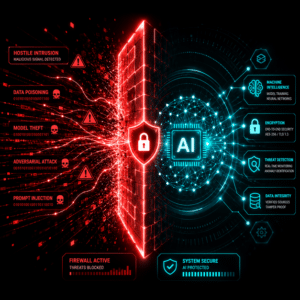

| AI agents in security operations are not conventional software tools. Because they can access data, call tools, make decisions, and act across connected systems, each agent needs its own identity, permissions, and controls. Safe deployment starts with a narrowly defined scope, least-privilege access for AI agents, tool-layer guardrails, and human approval for consequential decisions. CISOs also need an auditable AI agent inventory, production-readiness criteria, runtime monitoring, and clear measures of security and operational performance. These controls provide the evidence needed to determine when and where agent autonomy can expand safely. |
CISOs are under pressure to move AI from experimentation into frontline security work. AI agents in security operations can accelerate alert triage, investigations, threat hunting, detection engineering, and response when analyst capacity and attacker speed rarely align.
Unlike AI assistants that answer questions or conventional automation that follow predefined steps, agents can plan tasks, retrieve data, call tools, and act across connected systems with varying degrees of autonomy. That ability creates their value, but it also introduces operational, security, compliance, and accountability risks.
The readiness gap is already visible. The World Economic Forum’s Global Cybersecurity Outlook 2025 found that 66% of organizations expected AI to have the most significant impact on cybersecurity, yet only 37% had processes for assessing the security of AI tools before deployment.
Deploying AI agents in the SOC requires more than a successful proof of concept. CISOs need to define scope, guardrails, and governance; measure security and operational outcomes; and confirm an agent is ready before granting production access.
AI agents are a new kind of actor in your environment
Traditional security software usually operates within predefined workflows. An AI agent can decide which steps to take, choose among available tools, and initiate actions. That makes it an active identity in the environment, not another feature within a security platform.
To perform its role, an agent may authenticate to the SIEM, SOAR, EDR, identity, cloud, ticketing, threat intelligence, and collaboration platforms. Permissions can accumulate across these connections, enabling the agent to retrieve sensitive data, modify cases, or trigger actions in multiple systems. Its effective authority may exceed what any individual integration appears to permit.
This creates several potential failure paths. Prompt injection can influence tool selection, compromised credentials can expose connected systems, and flawed reasoning can lead to inappropriate tool use. Excessive permissions, data leakage, and unexpected action chains can magnify the impact. The risk emerges from the interaction among model behavior, identity, tools, data, and workflow authority.
A scoped identity per agent provides a foundation for control. Combined with least-privilege access, it lets you attribute, review, and revoke actions without disrupting other systems or shared integrations.
Start with scope: What should this agent be allowed to do?
Deploying AI agents in the SOC should begin with a defined security use case and business objective, not a broad mandate to use AI. The required level of authority depends on the task. Summarizing an alert carries far less risk than isolating an endpoint or deactivating an account, so these functions should not share the same permissions or approval requirements.
Authority can expand progressively as the agent demonstrates reliable performance:
- Summarize alerts and retrieve relevant context
- Recommend investigation steps
- Draft queries or detection rules
- Open or enrich cases
- Execute approved containment actions
- Act autonomously under narrowly defined conditions
For each stage, specify which tools, data sources, systems, assets, and environments the agent can access. Least-privilege access for AI agents should distinguish between permission to read, recommend, modify, and execute. Additional boundaries can restrict data sensitivity, action frequency, operating windows, affected assets, and permitted workflows. Time-bound credentials and just-in-time access can further limit exposure.
The scope should also document prohibited actions, including turning off security controls, deleting evidence, changing identity policies, or isolating critical systems without approval. Any new model, tool, integration, or use case changes the agent’s effective authority and should trigger another review. This makes scope, guardrails, and governance ongoing requirements rather than one-time deployment decisions.
Guardrails belong at the tool layer, not just in the prompt
Prompt-level instructions define how an agent is expected to behave. They can tell it not to access sensitive data, exceed its authority, or execute a high-risk action. However, instructions cannot reliably prevent an agent from attempting those actions, especially when it encounters prompt injection, manipulated content, or conflicting directions.
AI agent guardrails therefore need to be enforced at the identity, API, tool, workflow, and infrastructure layers. Evaluate every tool call against policy before execution. Allowlists can restrict available tools and commands, while schema validation, rate limits, transaction limits, and environmental boundaries constrain their use. Apply separate authorization requirements to actions with different risk levels. These controls prevent a prompt, retrieved document, or attacker from directing the agent beyond its approved access.
Guardrails should also define how the agent responds when it cannot proceed safely. Ambiguous instructions, missing context, policy conflicts, or control failures should cause it to stop and escalate rather than improvise. Logs should capture prompts, retrieved context, tool calls, outputs, approvals, and resulting actions to support investigation and audit.
This approach to tool-layer vs. prompt-level guardrails reflects the risks addressed in OWASP Agentic AI Threats and Mitigations guidance. Connecting the controls to runtime monitoring and containment enables anomalous behavior to trigger credential suspension, session termination, or agent isolation before it spreads.
Keep a human in the loop for consequential decisions
Human oversight should reflect an action’s potential impact and reversibility. Applying the same approval requirement to every task would limit efficiency without necessarily reducing risk. Agents can have greater autonomy for low-risk, reversible work such as summarizing alerts, enriching cases, or drafting queries.
Human-in-the-loop decision gates become essential when an action could disrupt operations, affect an individual, or be difficult to reverse. Isolating endpoints, deactivating accounts, blocking network traffic, changing production detections, deleting data, and contacting affected parties should require authorization from a designated person.
The approval process must specify who can authorize each action and what the agent must present. Analysts need sufficient evidence to understand the reasoning, proposed action, affected systems, and potential impact. Escalation paths should identify an alternate approver when urgent action is required.
Human approval also preserves accountability. An agent may recommend or execute an authorized action, but it cannot assume responsibility for the outcome. That distinction remains central to board-level accountability for AI risk.
Build the inventory before you build the program
Effective AI agent governance for security teams starts with knowing which agents exist and what they can do. The inventory should cover sanctioned agents, vendor agents embedded within larger security platforms, internally developed agents, and experimental tools that might otherwise escape review.
Each record should identify the owner, business purpose, model and version, operating environment, connected tools, data access, permissions, dependencies, approval requirements, and current status. Lifecycle records should capture testing results, incidents, control changes, model updates, and retirement decisions to make the AI agent inventory auditable.
Discovery cannot depend entirely on voluntary registration. Security teams need a process for identifying unsanctioned agents and integrations before agent sprawl and shadow AI create unmonitored access paths.
The inventory supports risk classification, access reviews, audits, incident response, and regulatory reporting. Governance should align with the NIST AI RMF and ISO/IEC 42001 while incorporating applicable EU AI Act compliance considerations. Assign executive ownership, with clear criteria for communicating material AI risks to the board.
Move from proof of concept to production safely
A successful demonstration shows that an agent can perform under controlled conditions, not that it is production ready. Proofs of concept rarely reflect real-world data volumes, adversarial inputs, workflow complexity, or operational dependencies. Closing the gap between proof of concept and production readiness requires testing how the agent behaves under less predictable conditions.
Sandbox testing should use realistic security scenarios involving incomplete data, conflicting evidence, malicious prompts, unavailable tools, permission failures, and unexpected system responses. Teams should validate the agent’s integration with the existing SIEM/SOAR stack and other controls while confirming that logs provide enough detail to reconstruct what it observed, decided, recommended, and executed. Rollback, credential revocation, agent isolation, and manual fallback procedures must also work as intended.
Deployment can then progress through observe-only mode, recommendation mode, approval-required execution, and narrowly bounded autonomy. Advancement should depend on defined criteria for accuracy, reliability, security, latency, auditability, containment, and analyst acceptance.
Production approval should remain conditional and reversible, not permanent. Model changes, new tools, revised permissions, and significant workflow updates can alter the agent’s behavior and risk. Each should trigger retesting and, when necessary, reduced authority. This staged approach to deploying AI agents in the SOC supports runtime monitoring and containment while preserving the ability to intervene.
The questions to ask before you buy
Evaluating AI security vendors requires more than comparing model accuracy or watching a controlled demonstration. CISOs need to examine the agent’s complete architecture, operating boundaries, dependencies, and governance model. The following evaluation questions for AI security can expose gaps before procurement:
- What actions can the agent take, and which require human approval?
- Does each agent have a unique, traceable identity, and can you restrict permissions by tool, data type, action, asset, and environment?
- Where are prompts, retrieved data, outputs, credentials, and logs stored?
- Is customer data used to train or improve vendor models?
- How does the vendor defend against prompt injection and unauthorized tool use?
- Which AI agent guardrails are technically enforced instead of prompt-based?
- Can customers review every tool call, approval, and resulting action?
- How are model, prompt, and agent updates communicated, tested, and documented?
- Can the agent be isolated or disabled without affecting the underlying security platform?
- What happens if a model, tool, or integration becomes unavailable?
- Which frameworks, certifications, and regulatory requirements does the product support?
- What evidence demonstrates reliable performance with real security data?
- What assistance does the vendor provide for incident investigation, audit, and regulatory reporting?
The answers should be specific, verifiable, and reflected in contracts and technical documentation. Vague assurances are not a substitute for enforceable controls, operational evidence, or accountable AI agent governance for security teams.
What to measure before and after deployment
Measurement should begin before deployment. Without a baseline, teams cannot decide whether changes in efficiency, detection, or response are attributable to the agent. Operational measures should include:
- Investigation and triage time
- Mean time to detect and respond
- Alert backlog and analyst time per case
- Escalation quality and detection coverage
- False-positive and false-negative rates
- Recommendations accepted, modified, or rejected
Agent-specific measures should track:
- Unauthorized or blocked tool calls
- Human overrides and permission exceptions
- Failed or incomplete tasks
- Policy violations and containment events
- Actions requiring rollback
- Time spent reviewing agent output
The ISC2 2025 AI Pulse Survey found that 70% of respondents from organizations actively using AI security tools reported positive results for team effectiveness. Demonstrating that value requires measuring outcomes. Adoption rates, task volume, and agent activity do not show whether security improved.
Compare results by use case and autonomy level, and watch for unintended effects such as faster handling paired with weaker investigations or more analyst rework. Defined thresholds should trigger additional testing, reduced permissions, retraining, suspension, or retirement. These measures support runtime monitoring and containment. Reporting should present productivity improvements alongside residual risk to security leaders and the board, reinforcing board-level accountability for AI risk.
Final thoughts: The real risk is deploying without a plan
AI agents in security operations can accelerate investigations, reduce repetitive work, and help teams respond to threats more quickly. The greater risk is not the technology itself. It is granting agents broad permissions, poorly defined objectives, inadequate monitoring, or authority that exceeds organizational controls.
Safe adoption depends on scope, guardrails, and governance, supported by unique identities, least-privilege access, human decision gates, an auditable inventory, runtime monitoring, and measurable outcomes. CISOs should expand autonomy only when operational evidence shows that both performance and controls justify it.
Explore CyberProof’s Agentic AI for modern security operations to see how AI agents and security experts can accelerate detection, investigation, threat hunting, and response while maintaining human oversight.