








Author: Jonathan Maresky, Head of Product Marketing

Every security leader is asking the same question:
How do we take advantage of AI agents without creating new operational risk?
Attackers are already using AI to move faster. Security teams need to respond in kind. But very few enterprises are ready to hand over security decisions to autonomous systems without trust, control, accountability, and measurable outcomes.
That is the problem CyberProof Agentic MXDR was built to solve.
Most SOCs do not lack data. They lack connected execution.
Analysts often work across SIEM, EDR, identity, email, cloud, SOAR, threat intelligence, vulnerability management, and ticketing systems. Each tool may contain part of the truth, but the analyst still has to assemble the full story:
- What happened?
- Which asset was involved?
- Is the user behavior normal?
- Is the threat relevant to our sector, geography, or technology stack?
- Is there an exposure that makes this more urgent?
- Which detection fired?
- Which controls are working?
- What should we do next?
This is why many SOCs remain too manual, too fragmented, and too reactive. They are surrounded by technology, but still dependent on human effort to connect the dots.
The business outcome: Faster defense with measurable control
We launched CyberProof Agentic MXDR to help enterprises move from reactive alert handling to continuous, threat-led defense.
The goal is not simply to automate more activity. The goal is to improve measurable security outcomes:
- Reduce manual triage and enrichment
- Accelerate acknowledgement, investigation, and response
- Improve detection quality and consistency
- Prioritize threats based on exposure and business context
- Reduce unnecessary customer escalations
- Increase autonomous resolution where it is safe and governed
- Give leaders visibility into what happened, who acted, how fast, and what improved
For large enterprises, this matters because AI adoption in the SOC is not only a technology question. It is also a trust question.
Security leaders need to know that AI outputs can be validated, agent actions can be governed, sensitive data can be protected, and outcomes can be proven.
That is why CyberProof combines AI agents, expert analysts, deterministic automation, and CDC Reveal360 into one co-managed service model.
Why other approaches fall short
The market is full of AI SOC tools and point agents. Many of them are useful:
- One agent may triage alerts
- Another may summarize cases
- Another may generate queries
- Another may tune detections
The problem is not that these agents lack value. The problem is that disconnected agents can create another layer of fragmentation.
If every agent works in isolation, the customer is still responsible for the operating model:
- Who coordinates the agents?
- Who validates the recommendation?
- Who decides when automation is safe?
- Who manages exceptions?
- Who proves that the service improved?
This is where many AI-led SOC approaches fall short. They focus on automation, but not enough on orchestration. They focus on speed, but not enough on control. They focus on individual agent capability, but not enough on end-to-end security outcomes.
CyberProof Agentic MXDR takes a different approach.
The CyberProof approach
CyberProof Agentic MXDR turns isolated agent activity into an accountable, co-managed security operations service.
The service orchestrates Anthropic, Microsoft, Google, third-party, client-developed, and CyberProof-built agents across the security lifecycle. CyberProof experts validate critical decisions, manage exceptions, and continuously improve the service.
Our approach is intentionally not “we have agents.” The differentiated value is ecosystem-wide agent orchestration across the cybersecurity operating model, from cybersecurity estate management to exposure management to defense management.
In practical terms, this means:
- Agents do the repeatable work
- Analysts validate the critical decisions
- Automation handles deterministic workflows
- CDC Reveal360 provides visibility into actions, outcomes, and improvement
- The service continuously learns from every case
CyberProof Agentic MXDR is built around the reality of enterprise security. Large organizations are not starting from a blank slate. They already have Microsoft, Google, SIEM, EDR, identity, cloud, SOAR, and SecOps investments. They may also have in-house AI capabilities or preferred third-party agents.
CyberProof meets clients where they are. The service is API-first and ecosystem-driven, designed to work with existing tools, platforms, data sources, and agent ecosystems instead of forcing a rip-and-replace transformation.
Why CyberProof is different
CyberProof is uniquely qualified to deliver Agentic MXDR because we are not approaching the SOC as a software-only problem.
We have years of experience operating enterprise SOCs for complex global organizations. That heritage matters. It gives us practical knowledge of:
- How alerts are investigated
- How escalations happen
- How customers make decisions
- How detections drift
- How response processes break
- Where automation is safe or unsafe.
CyberProof also brings deep human expertise across MDR, MXDR, threat intelligence, threat hunting, detection engineering, incident response, automation, cloud security, and exposure management.
Agentic AI works best when it is built around this operational knowledge, not separated from it.
Our acquisition of Interpres strengthened this model by adding CTEM and exposure management capabilities into the CyberProof operating framework. That allows Agentic MXDR to connect defense activity with exposure context, helping teams prioritize what matters most based on the threats, assets, vulnerabilities, controls, and business context that define real risk.
CDC Reveal360 is another major differentiator. It gives customers visibility into investigations, agent actions, analyst validation, service performance, exposure context, and measurable outcomes. Agentic MXDR should not operate as a black box. Reveal360 helps security leaders understand what happened, why it happened, who acted, how fast, and what improved.
CyberProof is also built around an API-first architecture and ecosystem approach. We work with Microsoft, Google, Anthropic, third-party agents, client-developed agents, and CyberProof-built agents. Our partnerships and hyperscaler alignment allow customers to extend existing investments while adopting agentic capabilities in a governed way.
This combination is what makes CyberProof different:
- MDR heritage
- Enterprise SOC operating experience
- Human expertise
- CTEM and exposure management through Interpres
- CDC Reveal360 outcome visibility
- API-first architecture
- Ecosystem orchestration
- Partnership with Anthropic
- Microsoft and Google alignment
- A co-managed service model built for trust, control, and accountability
The Agentic Framework realized: Agents, automation, analysts, and Reveal360
CyberProof Agentic MXDR combines these operating layers.
- SOAR and deterministic automation. Not every workflow needs frontier AI. High-volume, repeatable processes should be automated using structured playbooks where possible. SOAR automation can handle recurring investigation steps, gather evidence, validate indicators, close benign cases, and escalate only cases that require deeper review.
- Specialized AI agents. CyberProof uses purpose-built agents for specific security operations functions, including threat profiling, threat hunting, detection health checks, investigation support, detection engineering, EDR health checks, documentation, reporting, and GRC-related analysis.
- Human governance. Agents don’t own the security strategy. CyberProof analysts, engineers, threat intelligence specialists, and incident responders remain in the loop to validate outcomes, manage complex incidents, tune detections, approve high-impact actions, and improve playbooks.
- CDC Reveal360 outcome intelligence. Agentic MXDR should not operate as a black box. CDC Reveal360 gives leaders visibility into agent actions, analyst validation, case progress, service performance, risk trends, and improvement over time.
What this looks like in practice
Consider threat profiling:
Security teams are overwhelmed by generic threat intelligence. Thousands of indicators, reports, and vulnerability alerts may be published every day, but the important question is: which threats actually matter to this organization?
CyberProof’s Threat Profile Agent builds a tailored threat profile based on industry, geography, technology stack, and digital exposure. It helps answer who is likely to attack, how they may attack, and what the organization should do about it.
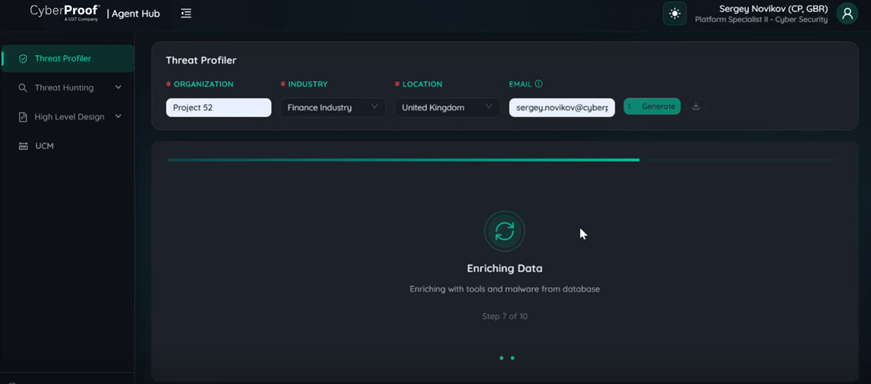
Screenshot of the Threat Profiler agent
That profile can then inform hunting, detection engineering, exposure prioritization, and response planning. Threat intelligence becomes an operational input, not a static report.
Now consider detection engineering:
Many enterprises run hundreds of detection rules, but rules can drift, stop triggering, use incomplete data sources, or contain logic issues that are difficult to test manually. CyberProof has developed agentic capabilities to review detection history, analyze rule logic, and identify rules that may not be working as expected.

Screenshot of the MITRE mapping agent
Another example is the Detection Engineering Golden Repository.
Detection engineering across many customers can become fragmented, with each environment maintaining its own logic, tuning, and updates. CyberProof’s golden repository model helps create a single source of truth so new detections, improvements, and refinements can flow consistently across environments while preserving customer-specific tuning.

Screenshot of the threat hunting agent
These are not abstract AI concepts. They are concrete product capabilities designed to improve SOC consistency, detection quality, and operational scale.
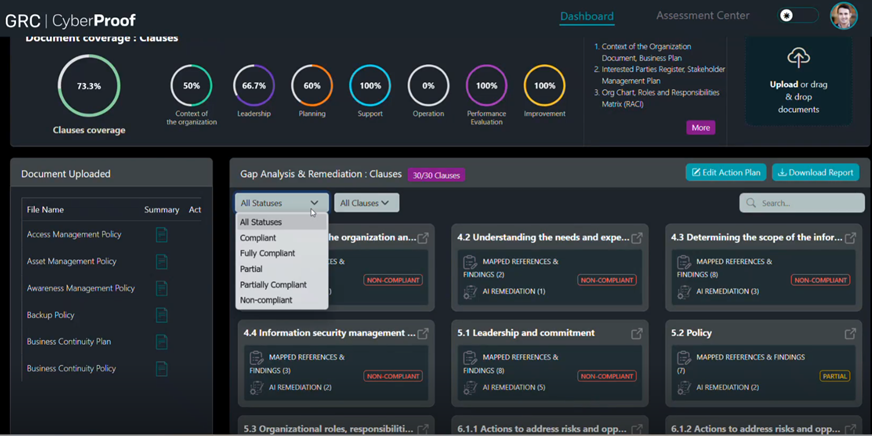
Screenshot of the GRC gap analysis agent
Built for trust, control, and accountability
Agentic AI can make security operations faster, but speed without control is not enough.
CyberProof Agentic MXDR’s guiding principles include:
- Human governance: Humans validate high-impact decisions, own outcomes, and maintain accountability.
- Ecosystem fit: The service works across Anthropic, Microsoft, Google, third-party, client-developed, and CyberProof agents.
- Threat-led execution: Active threat intelligence drives hunts, detections, exposure prioritization, and response.
- Data sovereignty and model choice: CyberProof supports client-approved model strategies, including private, public, hyperscaler-native, and customer-preferred LLM options, with controls over data access, usage, and retention.
- Continuous improvement: Every case improves agent logic, detections, automation, and service performance.
- Outcome visibility: CDC Reveal360 gives leaders visibility into agent activity, service performance, risk reduction, and business impact.
This is how CyberProof puts AI into action without losing the human factor.
From before to after Agentic MXDR
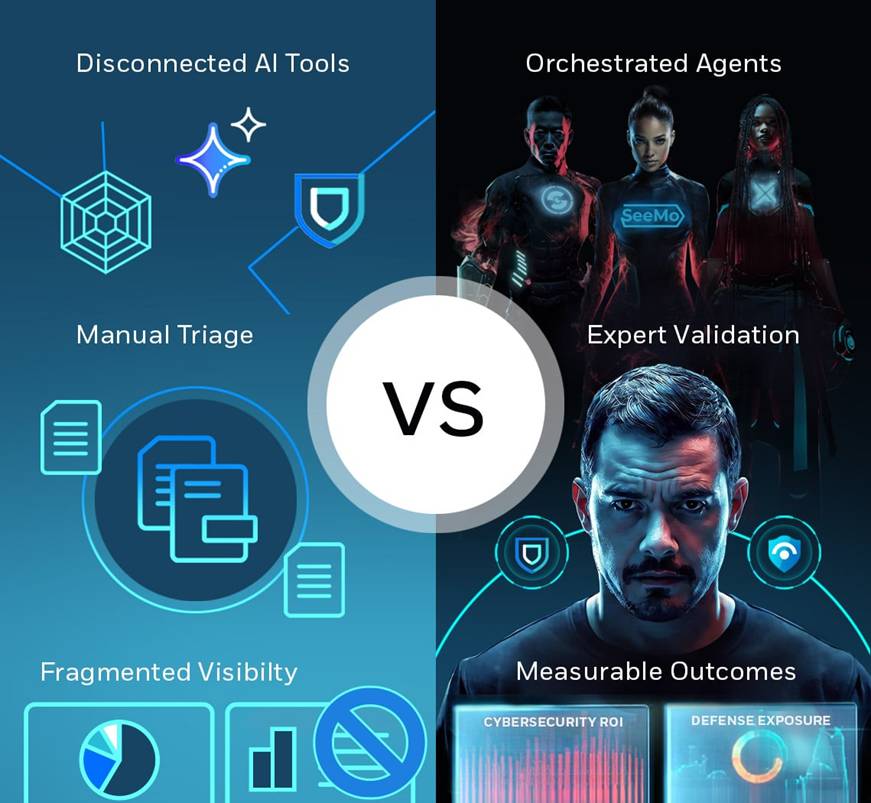
Before and after Agentic MXDR
Before Agentic MXDR, many SOCs look like this:
- Numerous point-solution consoles
- Manual enrichment
- Static detections
- Fragmented threat intelligence
- Repetitive triage
- Unclear ownership
- Alert fatigue
- Limited visibility into outcomes
After Agentic MXDR, the operating model changes:
- Coordinated agents
- Threat-led investigations
- Exposure-informed prioritization
- Automated enrichment
- Human validation
- Continuous detection improvement
- Fewer unnecessary escalations
- Measurable outcomes through CDC Reveal360
The shift is not just from manual to automated. It is from fragmented to orchestrated.
It is the move from disconnected tools and alert queues to a governed, agentic service model where AI agents, automation, analysts, and customers work together.
Proof from early deployments
We have been watching these outcomes carefully in our deployments in Q4 2025 and H1 2026.
In one before-and-after example, customers saw measurable improvements across speed, escalation, and autonomous handling:
- Mean Time to Resolve reduced by 80.53%
- Mean Time to Acknowledge reduced by 96.20%
- Mean Time to Triage reduced by 75.50%
- Cases escalated to the client reduced by 92.2%
- Autonomous Resolution Rate increased by 522%
These results show the practical value of combining agents, automation, human validation, and managed service delivery. The benefit is not just that AI moves faster. It is that the operating model becomes more consistent, more measurable, and easier to improve.
Summary
Agentic AI will continue to change how security operations work.
The question is not whether AI will be used in the SOC.
It already is.
The question is whether it will be connected, governed, measurable, and aligned to the outcomes that matter.
That is the purpose of CyberProof Agentic MXDR:
- Orchestrate every agent
- Defend end to end
- Prove every outcome
Next Steps
CyberProof Agentic MXDR is available now for large enterprises and mid-market organizations with complex hybrid environments.
For more insight, please join our launch webinar on July 23, as well as our deep-dive webinars and demos:
- Day in the life of L2/L3 analysts in an Agentic SOC
- Day in the life of a Threat Hunter and Detection Engineer in an Agentic SOC
- (And more to come!)
Security teams can begin with an Agentic MXDR Readiness Workshop to assess MDR/MXDR maturity, existing Microsoft or Google security investments, priority threat scenarios, automation opportunities, integration requirements, and practical next steps for agentic security operations.
And if you’re ready to speak with an Agentic MXDR expert, get a demo or schedule a deep-dive discussion, please click here.
