








Contributors: Archana Manoharan, Meena Madhavan, Aparna Kunnath Ajayan, Dhanunjaya Vuppala
Executive Summary
A deception alert triggered by the scanning of decoy backup infrastructure exposed a multi-week intrusion that began with valid credentials used through an internet-facing Citrix virtual desktop infrastructure (VDI) environment. The credentials had appeared in a stealer-log prior to the first confirmed external sign-in, and multifactor authentication (MFA) was not enforced on the access path at the time. Once inside, the threat actor expanded activity across virtual desktops, mapped the Active Directory (AD) environment, staged tools, performed large-scale account enumeration, and accessed files containing plaintext secrets.
The intrusion escalated from initial credential theft to domain-level control: a previously disabled privileged account was reset and re-enabled, privileged passwords were changed, and a service identity was added to the Domain Admins group. Outbound SFTP sessions were also observed.
Technical Details
Initial Access Through Compromised Credentials
Credentials for a legitimate user appeared in a stealer-log approximately five days before the first confirmed external Citrix login. An external public IP address (174.138.180.146) was subsequently associated with remote-interactive access to multiple virtual desktops. Because MFA was absent on this access path, valid credentials alone were sufficient to establish a desktop session. This activity is consistent with valid-account abuse rather than the exploitation of a Citrix software vulnerability.
Domain and Network Discovery
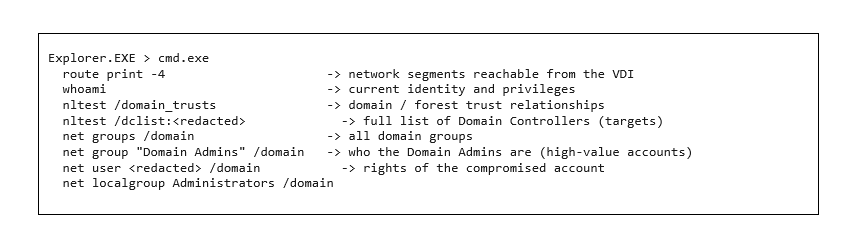
Within minutes of gaining initial access, the operator executed standard Windows commands to identify the logged-in context, network routes, domain trusts, domain controllers, local administrators, and domain privileged groups. The attacker also probed dozens of infrastructure systems, including domain controllers, backup servers, and database-related assets.
Tool Transfer and Masquerading
The threat actor obtained tools through public file-sharing services and staged them in user-profile directories. A copy of SoftPerfect Network Scanner was renamed to masquerade as a Windows service executable (MSInstallService.exe), while PowerShell scripts supported account and computer discovery. FileZilla and its SFTP helper (fzsftp.exe) were also executed.
| File / indicator | Detail |
| MSInstallService.exe | C:\Users\<redacted>\Pictures\ and \Documents\SAP\SAP GUI\ ; SHA256 c7513c97463246e693424e64943983bd49e6d8aa86b1e8fb4a98a437ae8bfef1 |
| Users.ps1 | C:\Users\<redacted>\Pictures\Users.ps1 ; SHA1 f6cb1b634e69b2f1dda725051df0d93f5c2d60e0 |
| comp.ps1 | C:\Users\<redacted>\7498\Pictures\comp.ps1 ; SHA1 6410edbfa1ac3723650b20b6176f55abf5c621aa |
| filezilla.exe | C:\Program Files\FileZilla FTP Client\filezilla.exe ; SHA1 63e6dafa76b3156916bcb175f6b01531a31173bf |
| Staging URLs | hxxps://temp[.]sh/ ; hxxps://gofile[.]io/ ; hxxps://send-anywhere[.]com/ ; hxxps://temp[.]sh/p1TXO/*.zip |
| Process evidence | filezilla.exe > fzsftp.exe -v |
Active Directory Enumeration
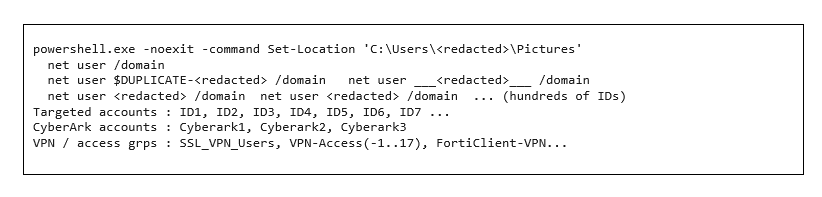
A PowerShell-driven loop issued approximately 41,000 domain-account lookups spanning employee, service, and privileged identities. Subsequent queries focused on high-value administrative, vault-related, VPN, and backup identities. The scale and focus of these queries indicate the targeted mapping of privilege escalation and lateral movement pathways.
Credential Access and Validation
The operator browsed network shares and opened files containing plaintext passwords, tokens, and provisioning scripts. Several harvested privileged credentials were tested against domain-controller shares—such as SYSVOL and IPC$—resulting in recorded failed authentication attempts. All exposed secrets discovered in these files should be treated as compromised.
| Category | Files opened (examples) |
| Plain-text passwords | \\<redacted>\e\server user ID Password.txt ; \\<redacted>\e\Scrum Do not delete\login details.txt ; \\<redacted>\d\password admin.txt ; \\<redacted>\d\password user1.txt ; \\<redacted>\d\pass.txt ; \\<redacted>\d\User2 password.txt ; \\<redacted>\User\Passwords.txt ; …\msolve password.txt |
| Tokens / keys | \\<redacted>\c$\Users\Administrator\Desktop\Sentinel one\<redacted> site token.txt ; \\<redacted>\…\Sentinel one\<redacted> site token.txt ; \\<redacted>\shared\Project_Access\projectadmin_Encrypted_Password.pwf |
| AD / identity scripts | \\<redacted>\Share$\Windows_ID_creation.ps1 ; \\<redacted>\Share$\Windows agents\CyberApp_ID_Creation.ps1 ; \\<redacted>\User\removebatch.ps1 & assignbatch.bat ; \\<redacted>\e$\Certcheck.ps1 |
| Other sensitive files | Access-control and DC door-access lists, EDC access list, TMC access logbook, a PowerShell transcript from servers |
| Example process tree | Explorer > NOTEPAD.EXE \\<redacted>\c$\…\<redacted> site token.txt ; notepad++.exe …\projectadmin_Encrypted_Password.pwf |
Privileged Account Takeover
Using an already privileged identity, the operator reset and re-enabled a disabled Domain Admin account, expanded its permitted logon hours, and authenticated to a domain controller. In a separate interactive PowerShell session on a domain controller, the attacker reset additional privileged account passwords and added a service identity to the Domain Admins group, establishing durable domain-wide administrative persistence.

File Changes and External Communication
Telemetry documented the movement of directories on a file server under a privileged identity. FileZilla/SFTP generated approximately 270 connections to two external IP addresses (216.158.226.110 and 216.158.226.100) over TCP/22, alongside minimal FTP traffic over TCP/21 and additional traffic to 172.32.1.175. Because the content and volume of the transferred files could not be verified, these connections serve as indicators of potential data staging or transfer rather than definitive proof of exfiltration.
| Evidence item | Detail |
| External servers | 216.158.226.110 and 216.158.226.100 – SFTP/22 (~270 connections) + a few FTP/21 |
| Other destinations | 172.32.1.175 (external) |
MITRE ATT&CK Techniques
| Technique | Observed behavior |
| T1078 / T1133 | Valid credentials through external remote services |
| T1018 / T1482 / T1069.002 | Host, trust and privileged group discovery |
| T1105 / T1036 | Tool transfer and renamed scanner |
| T1087.002 | Large-scale domain account discovery |
| T1552.001 / T1039 | Credentials in files and network share access |
| T1098 / T1098.007 | Password resets, account enablement and group membership |
| T1021.002 | Attempts to use privileged credentials over SMB |
| T1048 | External SFTP communications; data content unverified |
Indicators of Compromise (IOCs)
| Type | Indicator | Context |
| IPv4 | 174.138.180.146 | External Citrix login source |
| IPv4 | 216.158.226.110 | Observed SFTP destination |
| IPv4 | 216.158.226.100 | Observed SFTP destination |
| IPv4 | 172.32.1.175 | Additional destination |
| Domain | temp.sh; gofile.io; send-anywhere.com | Observed staging services; shared-use infrastructure |
| URL | hxxps://temp[.]sh/p1TXO/*.zip | Staged archive |
| SHA-256 | c7513c97463246e693424e64943983bd49e6d8aa86b1e8fb4a98a437ae8bfef1 | Renamed scanner sample |
| SHA-256 | 1b9badb1c646a19cdf101ac4f6fdd23bc61eaab8c9f925eb41848cea9fd0738e | Second scanner sample |
| SHA-1 | f6cb1b634e69b2f1dda725051df0d93f5c2d60e0 | Domain enumeration script |
| SHA-1 | 6410edbfa1ac3723650b20b6176f55abf5c621aa | Discovery script |
| SHA-1 | 0e67c37e46fd0b0ee2b761e120694cec5ea80a98 | Renamed scanner |
| SHA-1 | 63e6dafa76b3156916bcb175f6b01531a31173bf | FileZilla binary observed; not inherently malicious |
Hunting Query
Domain and Trust Reconnaissance
endpoint.os = 'windows' and (src.process.cmdline contains 'nltest /domain_trusts' or src.process.cmdline contains 'nltest /dclist' or src.process.cmdline contains 'route print' or src.process.cmdline contains 'net group' or src.process.cmdline contains 'net user')
Mass Domain-Account Enumeration
endpoint.os = 'windows' and (src.process.cmdline contains 'net user' or src.process.cmdline contains 'Users.ps1' or src.process.cmdline contains 'Get-ADUser')
Tool Staging and Masqueraded Scanner
endpoint.os = 'windows' and (src.process.name = 'MSInstallService.exe' or src.process.cmdline contains 'Users.ps1' or src.process.cmdline contains 'comp.ps1' or src.process.cmdline contains 'temp.sh' or src.process.cmdline contains 'gofile.io' or src.process.cmdline contains 'send-anywhere.com')
Credential Access from Network Shares
endpoint.os = 'windows' and (src.process.cmdline contains 'IPC$' or src.process.cmdline contains 'SYSVOL' or src.process.cmdline contains 'net use' or src.process.cmdline contains 'password' or src.process.cmdline contains 'credential')
Privileged Account Resets and Group Changes
endpoint.os = 'windows' and (src.process.cmdline contains 'Domain Admins' or src.process.cmdline contains '/active:yes' or src.process.cmdline contains 'Set-ADAccountPassword' or src.process.cmdline contains 'Enable-ADAccount' or src.process.cmdline contains 'Add-ADGroupMember' or src.process.cmdline contains '/add /domain')
FileZilla/SFTP Execution and Transfer Tools
endpoint.os = 'windows' and (src.process.name = 'fzsftp.exe' or src.process.name = 'filezilla.exe' or src.process.cmdline contains '216.158.226.110' or src.process.cmdline contains '216.158.226.100' or src.process.cmdline contains '172.32.1.175')
Persistence and Privileged Administrative Activity
endpoint.os = 'windows' and (src.process.cmdline contains 'schtasks /create' or src.process.cmdline contains 'New-ScheduledTask' or src.process.cmdline contains 'net localgroup administrators' or src.process.cmdline contains 'Add-LocalGroupMember' or src.process.cmdline contains 'reg add')
Recommended Actions
To mitigate the attack vectors observed in this intrusion and prevent similar credential-based escalations, security teams should prioritize the following containment, hardening, and detection measures:
- Enforce strong authentication: Require phishing-resistant MFA and conditional access policies on all internet-facing Citrix/VDI and privileged access paths, and investigate stealer-log exposures promptly.
- Contain compromised identities: Revoke active sessions, reset compromised credentials, rotate all secrets discovered in shared files, and review service-account delegation and vault access.
- Audit privileged accounts: Review
Domain Adminsand other privileged groups—along with recent account enablements, password resets, and logon-hour changes—reverting unauthorized modifications and auditing domain-controller access. - Harden administrative workflows: Restrict the interactive use of privileged service identities by enforcing tiered administration, privileged access workstations (PAWs), and just-in-time (JIT) elevation.
- Eliminate exposed secrets: Remove plaintext passwords and tokens from file shares and scripts, transitioning to managed secrets storage with strict access auditing.
- Restrict execution and detect anomalies: Block executable and script launches from user-writable directories, and configure alerts for renamed network scanners, mass account enumeration, and unexpected PowerShell activity on domain controllers.
- Investigate outbound traffic: Review proxy, firewall, DNS, and FileZilla logs for connections to the listed external destinations to determine whether data was transferred before declaring exfiltration.
- Safeguard backup infrastructure: Protect backup administration with isolated credentials, immutable or offline recovery copies, and alerting on unusual backup-account queries or configuration changes.
- Preserve telemetry and correlate detections: Retain VDI, domain controller, EDR, deception, SFTP, and Windows security logs, and build multi-event detections that correlate remote logon, enumeration, privilege changes, and outbound transfers.
Conclusion
This intrusion highlights how quickly threat actors can turn a single stealer-log exposure into full Domain Administrator control when internet-facing Citrix environments lack MFA and plaintext secrets remain accessible on network shares. Because the attacker relied heavily on valid credentials and legitimate administrative tools, early deception triggers and deep behavioral telemetry proved critical to uncovering the activity before ransomware could be deployed.
Moving forward, organizations must strengthen identity-first defenses by enforcing phishing-resistant MFA, auditing privileged group modifications, and removing hardcoded credentials from shared repositories. For security teams looking to stay ahead of credential-driven intrusions, the CyberProof combines advanced threat hunting, proactive threat exposure management, and MITRE ATT&CK-mapped detections to identify and contain lateral movement before adversaries reach critical domain infrastructure.
