









CASE STUDY – PROPERTY SERVICES
Property services group uses CTEM program to transform risk prioritization with CyberProof, reducing exposure by 30%
DOWNLOAD THE PDFAbout the client
Our client is a leading construction company delivering a range of services including infrastructure, fit out, and partnership housing across public and private sector clients. With many thousands of employees across multiple regional offices and project sites, its technology environment reflects this complexity, combining a broad set of security and IT controls to support large-scale, data-intensive operations.
The client’s challenge
As the client’s security program matured, the team was focused on a central question: how could they bring clarity and prioritization to risk across a large and complex environment?
The organization wanted a more contextual way to assess risk, with several related challenges shaping this need:
Prioritizing risk in a complex environment: Rather than treating every vulnerability or control gap equally, the team wanted to understand exposure in the context of exploitability, industry, and operational risk.
Validating that defenses were working as intended: The team also needed assurance that existing defenses were enabled, correctly configured, and performing effectively.
Maintaining layered coverage across the attack surface: A key concern was whether defensive coverage was balanced and resilient across the MITRE ATT&CK framework.
Benefits
- Significant reduction in attack surface: Total asset exposure reduced from 1,000 to approximately 620, cutting overall risk across the environment by 38%.
- Rapid mitigation of known exploited vulnerabilities: Assets affected by CISA Known Exploited Vulnerabilities (KEV) reduced by 52%, directly lowering exposure.
- Reduced campaign vulnerability exposure: A 30% reduction in campaign-linked vulnerability exposure, limiting susceptibility to targeted threat actor activity.
- Stronger executive visibility and decision-making: Clear, evidence-based insight into exposure enables improved communication with leadership.

Our solution
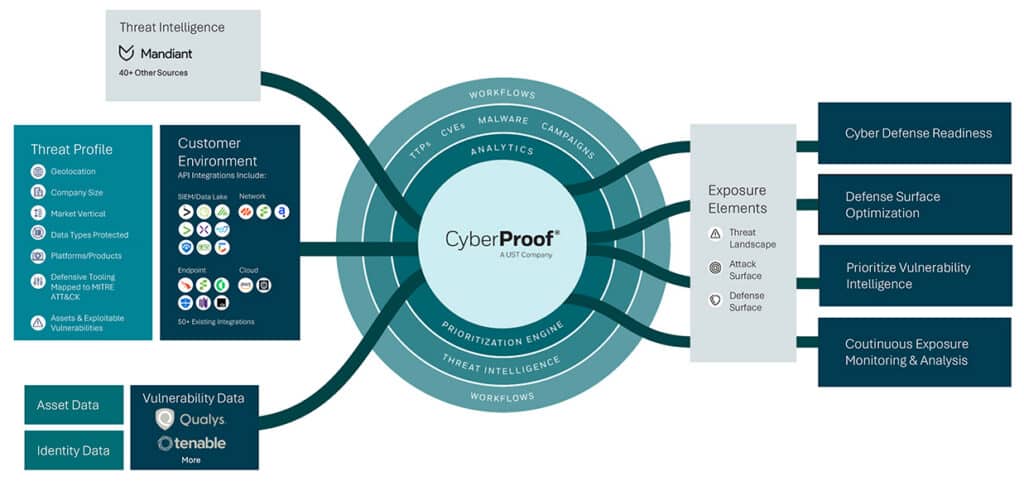
The CyberProof CDC Reveal360 platform helps clients operationalize a Continuous Threat Exposure Management (CTEM) practice. This implementation enabled the client to aggregate telemetry from across its security environment, processing approximately 600 GB of security telemetry daily, and aligning it to real-world attacker behavior.
Several capabilities were central to this approach:
Threat-informed prioritization: Aligning exposures to active attacker techniques and the organization’s threat profile, so the team can focus on the issues most likely to be exploited.
Continuous validation of control effectiveness: Ongoing assurance that security controls are enabled, correctly configured, and performing as expected.
Visibility across layered defenses: Mapping coverage across the attack surface, to assess how controls overlap and where gaps exist.
Executive-level risk assurance: The team can now quickly assess exposure and provide clear, evidence-based assurance to leadership on their current security posture.
A collaborative and evolving engagement: Ongoing collaboration and feedback helps to shape the evolution of the solution, ensuring it remains aligned to operational needs.
Results
Since deploying a CTEM program, the organization has achieved measurable reductions in exposure across many key metrics. Overall attack surface shrunk from 1,000 assets to approximately 620, while assets affected by CISA Known Exploited Vulnerabilities (KEV) fell by 52%, directly lowering exposure to active, in-the-wild threats. Campaign-linked vulnerability exposure dropped by a further 30%, limiting susceptibility to targeted threat actor activity. Critically, the programme has also transformed how the security team communicates risk upward. What once took days or weeks to identify, prioritize, and present to leadership can now be done in a fraction of the time, grounded in real-time exposure data and current threat activity.
Contact us
Explore how CyberProof can help you reduce mean time to respond in hybrid and cloud-native environments.