









Case Study – Manufacturing
A global manufacturer strengthens detection and improves MITRE coverage with Detection Engineering
DOWNLOAD THE PDFAbout the client
The client is a multinational manufacturing and technology company with operations across North America, Europe, and Asia. Their digital infrastructure includes cloud platforms, IoT-enabled production systems, and global ERP deployments.
The client’s challenge
Despite investing heavily in Security Information and Event Management (SIEM) and Endpoint Detection and Response (EDR) platforms, the client’s detection program remained reactive and inefficient. Challenges included:
- Time and resource constraints: The SOC was overwhelmed by alert noise, with nearly 40% of alerts turning out to be false positives.
- Poor alignment with business risks: Detection rules were not prioritized against the company’s most critical assets.
- Limited visibility into detection coverage: Despite hundreds of rules, the client wasn’t sure which MITRE ATT&CK techniques or actors they were monitoring.
- Reactive tuning: Rules were only updated after incidents occurred, meaning threat actors often had the advantage.
Benefits
- Reduced false positives: Alert noise dropped by 35%, saving an estimated 400 analyst hours per month and allowing the SOC to focus on genuine threats.
- Improved MITRE ATT&CK coverage: Coverage increased from 38% to 68% of high-priority techniques, ensuring visibility into the tactics most relevant to the client’s threat profile.
- Faster detection and response: Mean Time to Detect (MTTD) for critical incidents fell by 50%, and Mean Time to Respond (MTTR) dropped from industry-average 24–48 hours to under 6 hours.
- Operationalized threat intelligence: Weekly CTI integration ensured new detection rules were aligned with emerging adversary TTPs, boosting resilience against ransomware and APT activity.

Our solution
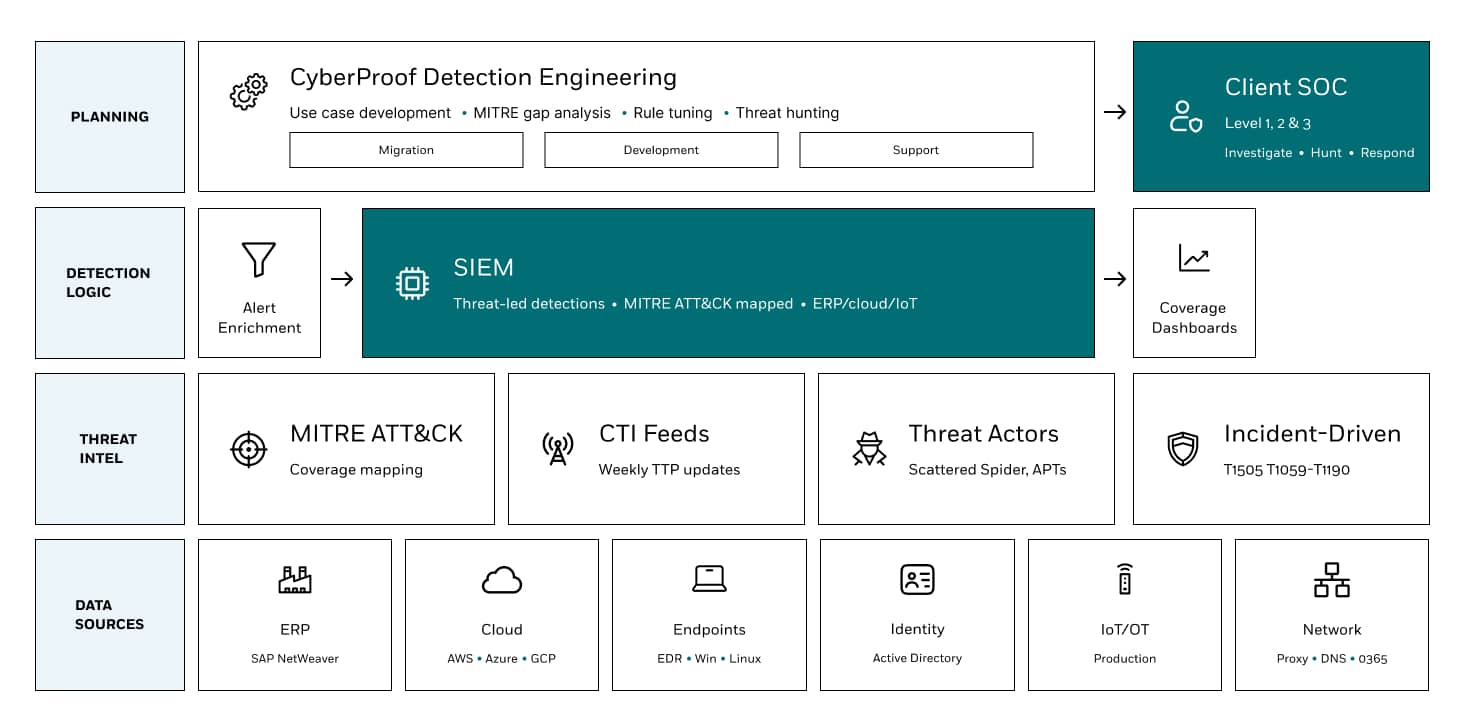
CyberProof deployed its Detection Engineering service designed to shift the client’s detection approach from reactive to threat-led and exposure-focused.
First, CyberProof supported migration of 202 use cases from Splunk to Google Chronicle, and the team then built 100 new rules as well as enabling Chronicle’s out-of-the-box detections.
Next, by aligning detections to business risks, MITRE ATT&CK gaps, and relevant threat actors, Detection Engineering enabled a measurable improvement in detection maturity and efficiency. Investigations into suspicious activity, including encoded PowerShell commands and SAP NetWeaver webshell exploitation attempts led the team to create high-fidelity detections that strengthened overall defenses.
Results
Within 6-9 months the client moved from reactive detection to a proactive, exposure-driven defense strategy. By aligning detection content with the most relevant adversaries and techniques, CyberProof helped the client reduce business risk tied to ERP downtime and intellectual property theft. The client also saw a measurable reduction in wasted analyst hours and redundant tool spend, improving SOC productivity and cost-efficiency.
Today, clear MITRE-based reporting provides board-level visibility into detection coverage, and demonstrates continuous improvement and regulatory alignment. Regular health checks, gap analysis, and continued threat intelligence updates ensures the detection program continues to evolve in step with the threat landscape.
Contact us
Explore how CyberProof can help you reduce exposure and uncover unknown risks with detection engineering in hybrid and cloud-native environments.