








Agentic SOC is the next step for security teams that need speed, scale, and control. It uses AI agents to handle repeat tasks across the SOC. It also keeps analysts in charge of risk calls, rare events, and response steps that need judgment.
The goal is simple. Cut the time spent on manual work. Raise the quality of each case. Turn threat intel into action. Give leaders a clear view of risk, work, and value.
This is where AI in Cybersecurity is moving now. It is no longer just a chat tool for summaries. It is becoming a set of task-based agents that can enrich alerts, map threats, hunt for signs of attack, draft case notes, and guide approved response.
What an Agentic SOC Means for Enterprise Teams
An Agentic SOC is a SOC model in which AI agents perform defined security tasks. Each agent has a role, a scope, and a control point. One agent may build a threat profile. Another may map events to MITRE ATT&CK. Another may generate a hunt query. Another may summarize an alert for analyst review.
Agentic security operations are different from basic automation. SOAR playbooks follow fixed rules. Agents can use context, reason over data, and pass findings to other agents. This makes the SOC more adaptive.
A mature Agentic SOC does not remove people. It changes their work. Analysts spend less time copying data between tools. They spend more time on risk, scope, impact, and response.
Why the Traditional SOC Needs a New Model
Alert Volume Is Now a Board-Level Issue
Modern tools are better at finding real signs of risk. That creates a new problem. The SOC may face many true signals at once.
Alerts now come from endpoint, cloud, identity, email, SaaS, network, and data tools. Each signal may be useful. But the SOC still has to know what matters first.
Agentic SOC models help by adding context at speed. They can enrich alerts with asset value, threat intel, user risk, known exposure, and prior case data.
Manual Case Work Slows Response
Many SOC steps are still manual. An analyst may need to check logs, search threat feeds, review asset data, map tactics, write notes, and send updates.
These steps take time. They also vary by person and shift. That creates uneven service quality.
AI agents can standardize much of this work. They can gather facts, prepare a timeline, show likely impact, and list next actions. The analyst can then accept, reject, or refine the output.
Tool Sprawl Hides the Real Story
Large firms often have strong tools but weak flow between them. SIEM, EDR, XDR, cloud, identity, ITSM, and threat intel tools may not share enough context.
Agentic managed extended detection and response helps connect these parts. It creates a managed flow from signal to insight to action. It also helps teams keep their current tools while raising the value of those tools.
Core Capabilities of an Agentic SOC
Multi-Agent Workflows Across the Security Lifecycle
The main value of an Agentic SOC is not one triage bot. It is the way agents work together.
Key agent roles include:
- Threat profiler agents that rank threat actors, campaigns, and methods.
- MITRE mapping agents that check tactics, techniques, and gaps.
- Threat hunting agents that build queries across SIEM, EDR, and cloud data.
- Investigation agents that enrich alerts and build case timelines.
- Case summary agents that explain facts, actions, and next steps.
- EDR health agents that check sensor status and policy drift.
- QA agents that compare case work with customer SOPs.
Together, these agents form a live work cycle. Threat intel drives hunts. Hunts shape new rules. Rules improve alerts. Case results guide the next tuning step.
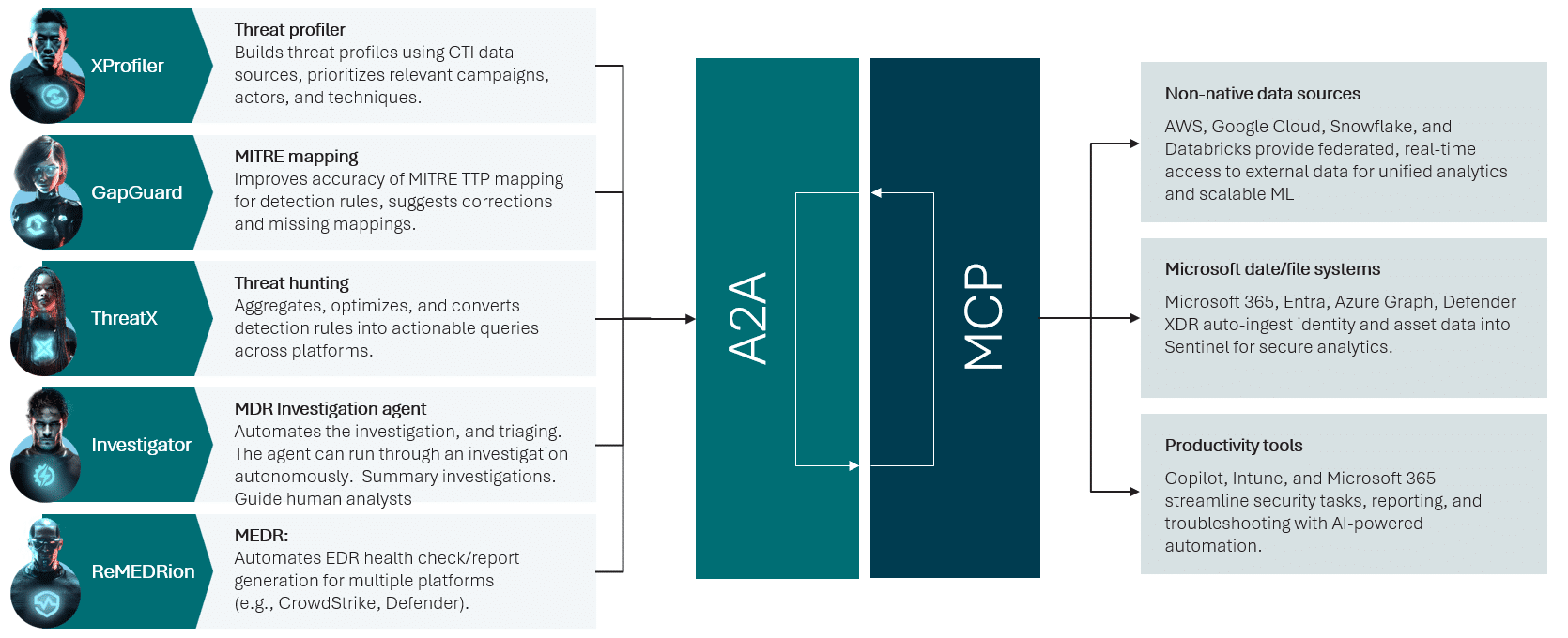
CyberProof’s AI Agents and framework
Human Control for High-Risk Actions
AI in Cybersecurity needs clear guardrails. Agents should not have open-ended control.
A strong model defines:
- Which agents can act on their own.
- Which actions need analyst approval.
- Which users, hosts, or systems need special care.
- Which logs and notes must be stored.
- Which changes need change control.
- Which errors must trigger review.
This matters for endpoint isolation, account changes, blocking rules, and new detection logic. Speed is useful only when it is safe.
Threat-Led Priorities for Real Risk
Not all alerts deserve the same effort. The SOC should focus on threats that matter to the business.
| Priority Lens | Question for the SOC | Value Created |
|---|---|---|
| Threat relevance | Which actors target our sector or region? | Better focus |
| Asset context | Which systems matter most to the business? | Better triage |
| Exposure data | Which assets are open to known attack paths? | Faster fixes |
| Detection gaps | Which tactics can we miss today? | Stronger coverage |
| Response fit | Which actions can we approve fast? | Faster containment |
This is how Agentic security operations move the SOC from alert-first to risk-first.
How Agentic MXDR Expands MDR
Agentic MXDR builds on MDR, XDR, SOAR, threat intel, threat hunting, and detection work. It is a managed service model that uses AI agents and expert analysts together.
Agentic MXDR should help the customer use what they already own. It should connect with SIEM, EDR, XDR, cloud, identity, email, and ITSM tools. It should not force a full tool shift before value starts.
The best use of Agentic managed extended detection and response is to join three things:
- AI agents for speed, scale, and repeat work.
- Analysts for judgment, trust, and control.
- A co-managed service layer for reports, review, and shared action.
This creates value for CISOs, CIOs, and SOC Managers. It reduces manual load. It also gives clearer proof of what the SOC did, why it did it, and where risk changed.
Reference Model for Agentic Security Operations
Data Layer for Shared Context
Agents need the right data. Useful sources include endpoint events, identity logs, cloud alerts, email signals, SaaS logs, network data, vulnerability data, asset records, and threat intel.
The goal is not to move all data into one place. The goal is to make context available when the case needs it. A good model can use cloud-native tools, hyperscaler data, third-party tools, and custom controls.
Agent Layer for Defined Work in the Agentic SOC
Each agent needs a defined task. It also needs clear inputs, allowed outputs, and review rules.
| Agent Type | Input | Output |
|---|---|---|
| Threat profiler | CTI feeds and customer profile | Ranked actors and campaigns |
| MITRE mapper | Rules and case evidence | Technique mapping and gaps |
| Hunt builder | Hypotheses and indicators | Search queries and logic |
| Investigator | Alerts and telemetry | Timeline and next action |
| Case summarizer | Case notes and actions | Clear case summary |
| EDR health checker | EDR status and policy data | Coverage and drift report |
This layer is where Agentic SOC design becomes real. The agents must be useful, tested, and tied to SOC process.
Service Layer for Visibility
Leaders need to see the work. A co-managed platform should show case status, key metrics, open actions, service trends, and risk posture.
This layer also supports shared work between the SOC, IT, security teams, and leaders. It makes AI output reviewable. It also helps prove value.
High-Value Use Cases for SOC Leaders
The first use cases should be safe, common, and measurable. Start where agents can remove work without adding risk.
Strong starting points include:
- Alert enrichment with asset and threat context.
- Case summary drafts for analyst review.
- MITRE ATT&CK mapping checks.
- Threat hunting query creation.
- EDR health and coverage checks.
- Detection gap review.
- SOC case QA against SOPs.
- Guided response notes for approved actions.
These use cases fit Agentic SOC adoption because they add speed but still keep people in control. They also build trust across the team.
Operating Metrics That Prove Value for an Agentic SOC
An Agentic SOC should be measured by outcomes, not hype. CISOs need to show risk reduction. CIOs need to show better use of platforms. SOC Managers need to show faster and more stable work.
| Metric | What It Shows |
|---|---|
| Mean time to acknowledge | How fast the SOC starts work |
| Mean time to investigate | How fast facts are gathered |
| Mean time to respond | How fast action is ready |
| Agent-assisted case rate | How often agents reduce manual work |
| QA pass rate | How consistent the case work is |
| Detection gap closure | How fast weak spots are fixed |
| Hunt-to-rule conversion | How often hunts improve defense |
| EDR health coverage | How ready the estate is |
| Analyst time saved | How much work shifts to higher value |
These metrics help make Agentic MXDR a business case, not just a tool choice.
CyberProof’s Agentic SOC and Agentic MXDR Approach
CyberProof’s Agentic MXDR approach is built around co-managed, threat-led security. It brings MDR, extended detection and response, threat intel, threat hunting, automation, and AI agents into one service model.
The model uses human-in-the-loop oversight. Analysts validate outcomes, handle complex incidents, guide response, and tune the process. Agents support repeat work, context gathering, triage, investigation, summary, health checks, MITRE mapping, and hunt creation.
The approach also supports cloud-first and vendor-aware operations. It aligns with major ecosystems such as Microsoft and Google. It can also evaluate third-party and custom agents when they fill a real gap.
This matters for large firms. Most do not want another isolated tool. They need Agentic security operations that fit their stack, their risk profile, and their process.
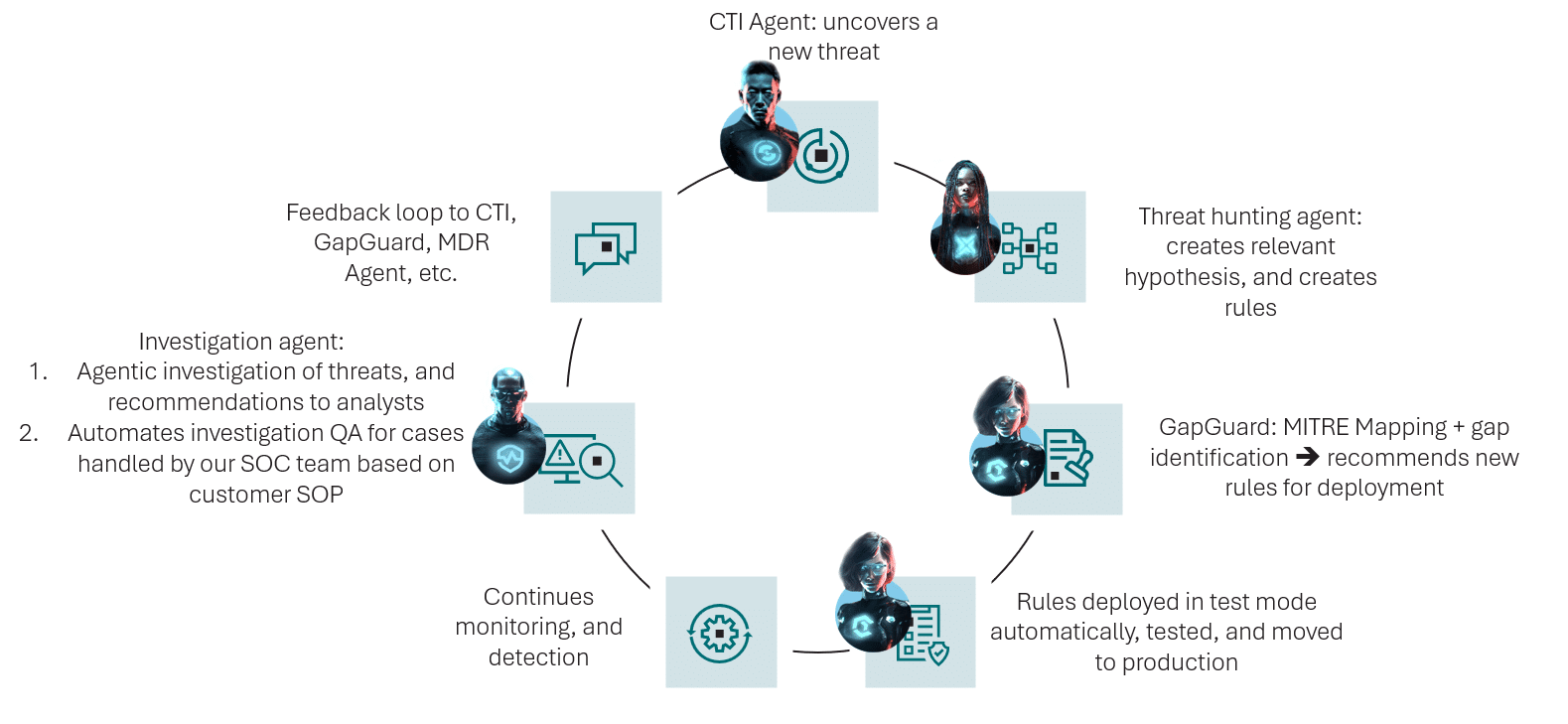
Threat led use-case generation
Adoption Roadmap for an Agentic SOC
Start With Low-Risk, High-Volume Tasks
Begin with work that is common and easy to review. Case summaries, alert enrichment, EDR health checks, and MITRE mapping are good first steps. They save time and create trust.
Add Guided Investigation and Hunting
Next, use agents to support triage, timelines, hunt queries, and detection gap checks. These steps need more data access. They also create more value.
Build Closed Feedback Loops
The mature stage links agents together. Threat intel informs hunts. Hunts inform rules. Rules improve alert quality. Case QA improves the next case. Reports show the gain in speed, quality, and risk posture.
This is the point where Agentic SOC becomes a live operating model.
Final View: Agentic SOC With Control and Proof
Agentic SOC is not a slogan for full autonomy. It is a practical model for faster, safer, and more consistent defense.
Agents handle repeat tasks. Analysts keep control. Leaders gain clearer proof of value. The SOC shifts from reactive alert handling to continuous, threat-led action.
For CISOs, the value is risk focus. For CIOs, it is better use of security spend. For SOC Managers, it is higher quality with less manual strain.
AI in Cybersecurity will keep changing fast. The right path is not blind trust in agents. It is Agentic security operations with clear scope, strong guardrails, shared metrics, and expert human review. Agentic MXDR gives enterprises a way to get there with service accountability and measurable progress.