








Exposure Assessment Platforms are becoming a strategic control layer for enterprises that need to reduce exploitable cyber risk across hybrid attack surfaces. They help security leaders move beyond isolated vulnerability lists and toward a governed, contextual, and business-aligned exposure management model.
For CISOs, CIOs, and SOC Managers, the objective is not simply to find more issues. The objective is to understand which exposures matter most, why they matter, who owns them, and how quickly the organization can reduce the associated risk. This requires continuous discovery, exposure enumeration, contextual enrichment, risk prioritization, workflow integration, and executive reporting.
Exposure Assessment Platforms support this shift by creating a single operating view of exposures across cloud, identity, endpoint, network, application, external, and hybrid environments. When implemented well, they improve risk visibility, strengthen remediation discipline, and help security teams focus effort where it can produce measurable risk reduction.
Why Exposure Assessment Platforms Matter Now
Enterprise attack surfaces now change faster than traditional vulnerability management processes can handle. Cloud workloads scale on demand. SaaS applications expand without central approval. Remote endpoints move between trusted and untrusted networks. Identity entitlements accumulate over time. Containers, APIs, unmanaged devices, and third-party digital assets create exposure paths that may not appear in conventional scans.
This creates a visibility and prioritization problem. Security teams may know that thousands of findings exist, but they may not know which ones are reachable, exploitable, business-critical, or already covered by compensating controls. Infrastructure teams may receive remediation tickets without enough context to understand urgency. Executives may see vulnerability volume without understanding true risk.
Exposure Assessment Platforms matter because they connect technical findings to operational and business context. They help answer higher-value questions:
- Which exposed assets support critical business services?
- Which vulnerabilities are actively exploitable or linked to known attacker behavior?
- Which misconfigurations create realistic attack paths?
- Which remediation actions will reduce the most risk?
- Which teams own the required fixes?
For modern security programs, this context is essential. Attackers do not treat vulnerabilities, misconfigurations, weak identities, and exposed services as separate issues. They combine them into paths. Exposure Assessment Platforms help defenders see and disrupt those paths earlier.
What Exposure Assessment Platforms Actually Do
Exposure Assessment Platforms continuously identify, analyze, and prioritize exposures across a broad range of assets. These exposures can include software vulnerabilities, configuration weaknesses, compliance gaps, unmanaged systems, identity risks, weak controls, internet-facing services, and exploitable relationships between assets.
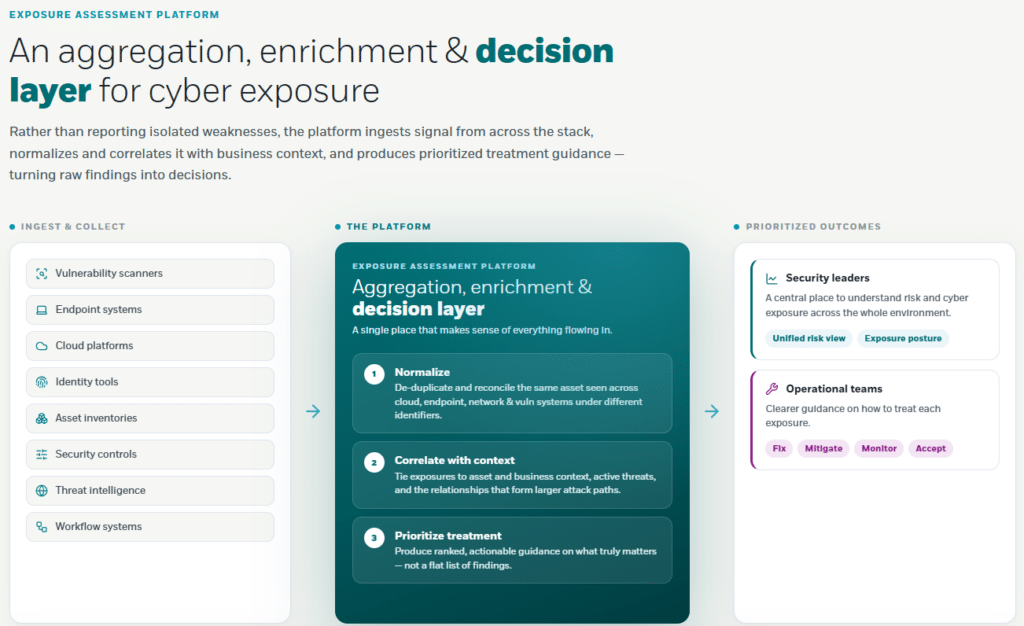
The platform operates as an aggregation, enrichment, and decision layer. It collects or ingests data from scanners, endpoint systems, cloud platforms, identity tools, asset inventories, security controls, threat intelligence sources, and workflow systems. It then normalizes this data, correlates it with asset and business context, and produces prioritized treatment guidance.
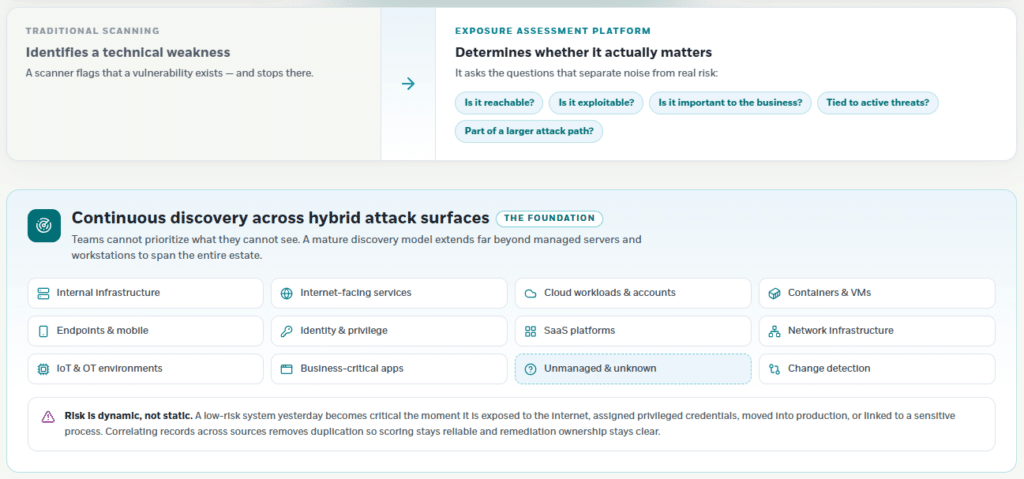
This is different from traditional vulnerability scanning. A scanner may identify a technical weakness. An Exposure Assessment Platform should help determine whether that weakness is reachable, exploitable, important to the business, associated with active threats, or connected to a larger attack path.
The result should be a more complete view of cyber exposure. Security leaders gain a central place to understand risk, while operational teams receive clearer guidance on what to fix, mitigate, monitor, or accept.
Continuous Discovery Across Hybrid Attack Surfaces
Continuous discovery is the foundation of exposure assessment. Security teams cannot prioritize assets and exposures that they cannot see. In large enterprises, asset visibility must extend beyond managed servers and workstations.
A mature discovery model should include:
- Internal infrastructure
- Internet-facing services
- Cloud workloads and cloud accounts
- Containers and virtual machines
- Endpoints and mobile assets
- Identity systems and privilege structures
- SaaS platforms
- Network infrastructure
- IoT and OT environments
- Business-critical applications
- Unmanaged and unknown assets
Discovery must also support change detection. A system that was low risk yesterday may become critical if it is exposed to the internet, assigned privileged credentials, moved into a production segment, or linked to a sensitive business process. Static inventories cannot support this level of decision making.
Exposure Assessment Platforms should therefore correlate asset records from multiple sources and reduce duplication. The same asset may appear in cloud, endpoint, network, and vulnerability systems under different identifiers. Without normalization, risk scoring becomes unreliable and remediation ownership becomes unclear.
Exposure Enumeration Beyond Vulnerability Scanning
Exposure enumeration expands the program beyond CVEs. A vulnerability may be one exposure type, but it is not the only one that matters. Attackers often exploit weak configurations, excessive permissions, missing controls, exposed services, unmanaged assets, and poor segmentation.
Examples of relevant exposures include:
- Publicly exposed administrative interfaces
- Misconfigured cloud storage
- Excessive identity entitlements
- Unsupported operating systems
- Missing endpoint controls
- Weak encryption settings
- Exposed secrets or credentials
- Unpatched critical services
- Insecure network paths
- Gaps in logging or monitoring coverage
This broader view is important because business risk often comes from combinations of weaknesses. A medium-severity misconfiguration on a critical internet-facing asset may present more risk than a high-severity vulnerability on an isolated, non-critical system.
Exposure Assessment Platforms should help security teams understand these combinations. The goal is not to create more findings. The goal is to identify which conditions create meaningful risk and which actions will reduce that risk fastest.
How Risk Prioritization Becomes Business Context
Risk prioritization is where Exposure Assessment Platforms create strategic value. Traditional vulnerability programs often rely heavily on technical severity. Severity is useful, but it does not provide enough context for enterprise decision making.
A better prioritization model considers several factors at once. These include exploitability, asset criticality, business function, internet exposure, identity privilege, threat intelligence, attack path relevance, control coverage, and remediation status. This helps security teams focus on the exposures most likely to affect business outcomes.
For example, a vulnerability on a non-critical internal system may not deserve the same urgency as a less severe weakness on a payment application, identity platform, or operational technology asset. Likewise, an exposure with active exploitation in the wild may require faster action than a theoretical issue with no known exploitation path.
Business context also improves communication with executives. Boards and senior leaders do not need long lists of technical findings. They need to know whether critical services are exposed, whether remediation is improving, whether accepted risk is increasing, and whether security investment is reducing the probability of disruption.
Exposure Assessment Platforms make this conversation more precise. They connect technical exposure to operational and business impact.
Threat Intelligence, Exploitability, and Asset Criticality
Threat intelligence gives exposure prioritization a real-world lens. Not every vulnerability is equally likely to be exploited. Not every exposed service is equally valuable to attackers. By using threat intelligence, security teams can identify issues associated with active exploitation, adversary tactics, exploit kits, ransomware operations, or common attack patterns.
Exploitability is also important. A vulnerability may have a high severity score, but if it is not reachable, not weaponized, or protected by effective controls, its practical risk may be lower. At the same time, a lower-severity issue may become urgent if it enables access to a privileged identity tier or critical business service.
Asset criticality completes the picture. Security teams should know whether an asset supports revenue, patient care, manufacturing operations, regulated data, executive communications, or core infrastructure. Without this context, prioritization remains too technical and may not reflect business reality.
The strongest prioritization models combine:
- Threat activity
- Exploit availability
- Asset criticality
- Business impact
- Network accessibility
- Identity privilege
- Control effectiveness
- Exposure age
- Remediation feasibility
This combination makes risk decisions more defensible.
Security Control Context and Attack Path Visibility
Security control context helps teams avoid both overreaction and underreaction. The same vulnerability can carry different levels of risk depending on whether the asset is monitored, segmented, protected, hardened, or isolated. Exposure Assessment Platforms should account for these controls when calculating priority.
Attack path visibility adds another layer of value. Instead of viewing exposures as isolated findings, attack path analysis shows how weaknesses can combine. A public-facing service, weak credential, excessive privilege, and misconfigured cloud role may form a route to a high-value system.
This is especially useful for SOC teams. Attack paths can guide threat hunting, detection engineering, alert triage, and incident response preparation. They help analysts understand which assets deserve heightened monitoring and which exposure chains could lead to material impact.
For remediation teams, attack path visibility helps explain why a finding matters. A ticket that says “patch this vulnerability” may compete with many other tasks. A ticket that shows how the issue contributes to a route into a critical environment is more actionable and more likely to gain priority.
Core Capabilities CISOs Should Expect from Exposure Assessment Platforms
An enterprise-grade Exposure Assessment Platform should provide more than central reporting. It should support the full exposure management life cycle from discovery through validation and governance.
Core capabilities should include:
- Broad asset discovery across internal, external, cloud, identity, endpoint, application, IoT, OT, and hybrid environments.
- Exposure enumeration for vulnerabilities, misconfigurations, weak controls, compliance gaps, unmanaged assets, and risky identities.
- Data normalization to correlate duplicate asset records and unify fragmented telemetry.
- Contextual enrichment using threat intelligence, asset criticality, ownership, business function, exploitability, and control data.
- Risk-based prioritization that moves beyond static severity scores.
- Attack path analysis to identify chained exposures and routes to critical systems.
- Workflow integration with IT service management, security operations, risk management, cloud security, endpoint, and patching platforms.
- Remediation guidance that is specific enough for infrastructure, cloud, endpoint, application, and identity teams.
- Exposure life cycle tracking from detection to assignment, remediation, mitigation, exception, validation, and closure.
- Role-based dashboards for CISOs, CIOs, SOC teams, vulnerability managers, risk teams, and operational owners.
- Automation that supports high-volume enterprise environments without creating unnecessary noise.
The most valuable platforms create a shared operating model. Every high-priority exposure should have context, priority, owner, recommended action, status, and measurable business relevance.
Operationalizing Exposure Data in the SOC
SOC teams need exposure data that improves detection, triage, investigation, and response. When exposure data is isolated in vulnerability management tools, analysts often lack the context needed to judge whether an alert represents material risk.
Exposure Assessment Platforms can enrich SOC workflows by showing whether an alerted asset is business-critical, externally exposed, vulnerable to known exploited issues, missing controls, or part of a known attack path. This helps analysts make better decisions faster.
The SOC can also use exposure data proactively. High-risk exposure views can guide detection tuning, threat hunting, attack simulation, control validation, and response planning. Instead of waiting for alerts, SOC teams can identify which exposure chains deserve closer monitoring.
This is an important shift. The SOC becomes not only a response function but also a source of exposure intelligence. SOC Managers can use the platform to align detection coverage with real attack surface risk. They can also identify recurring exposure patterns that increase alert volume or incident probability.
For security operations, the key outcome is precision. Analysts gain context before an incident occurs, not only after compromise is suspected.
SIEM, SOAR, ITSM, and Workflow Integration via Exposure Assessment Platforms
Integration depth determines whether an Exposure Assessment Platform becomes operationally useful. A dashboard alone does not reduce risk. Risk reduction happens when prioritized insights move into established workflows and drive action.
SIEM integration can enrich alerts with exposure context. SOAR integration can trigger response playbooks or automated checks. ITSM integration can create, assign, update, and close remediation tickets. Risk management integration can support exceptions, acceptance workflows, and audit evidence.
Bidirectional integration is especially important. A one-way ticket export may create work, but it may not reflect ticket updates, ownership changes, compensating controls, exception approvals, or closure validation. Without feedback loops, dashboards become stale and teams lose trust.
Security leaders should evaluate whether the platform can work with existing processes. The best architecture improves the operating model without forcing unnecessary disruption.
Ownership, SLA Tracking, and Remediation Loops
Exposure reduction depends on accountable ownership. Every high-priority exposure should map to a system owner, application owner, infrastructure team, cloud team, identity team, or risk decision maker. Without ownership, prioritization remains theoretical.
SLA tracking adds discipline. Not every exposure requires the same remediation timeline. An actively exploited vulnerability on an internet-facing critical asset may require urgent action. A lower-risk internal issue may follow a longer remediation window. The platform should support differentiated policies based on risk.
A strong remediation loop includes:
- Exposure detection
- Risk scoring
- Owner assignment
- Remediation guidance
- SLA tracking
- Exception management
- Mitigation validation
- Closure confirmation
- Trend reporting
This life cycle turns exposure assessment into managed risk reduction. It also creates evidence for executives, auditors, and operational leaders.
Deployment Models and Architecture Trade-Offs
Exposure Assessment Platforms can be delivered through several architecture models. The right model depends on regulatory constraints, data governance, asset types, scale, integration requirements, and internal operating maturity.
| Deployment Model | Best Fit | Advantages | Trade-Offs |
|---|---|---|---|
| SaaS-native | Cloud-first and hybrid enterprises | Fast deployment, elastic analytics, easier updates, broad integration options | May raise data residency or sovereignty concerns |
| Agent-based | Environments needing deep endpoint and server telemetry | Rich asset context, persistent visibility, stronger local detail | Requires agent rollout, maintenance, and coverage governance |
| Agentless/API-only | Cloud, SaaS, and external attack surface use cases | Lower endpoint overhead, fast integration, strong fit for dynamic cloud assets | May miss local system context or unmanaged internal assets |
| Hybrid | Regulated or complex global enterprises | Balances centralized analytics with local data collection | Requires more design, integration planning, and operational coordination |
| On-premises/private cloud | Sensitive, isolated, or highly regulated environments | Greater control over infrastructure and data location | Higher maintenance, slower updates, and possible integration constraints |
Architecture should not be selected only for speed. Security leaders should map the deployment model to data classification rules, operational constraints, cloud strategy, regulatory requirements, and remediation ownership.
For example, a SaaS-native model may fit a cloud-first enterprise with mature integration practices. A hybrid or private model may be better for organizations with strict data handling, air-gapped environments, or regional sovereignty obligations.
Buyer Challenges That Can Derail EAP Value
Many Exposure Assessment Platform initiatives underperform because the buying process focuses on features instead of operating outcomes. A platform may be technically capable, yet the program may still struggle if objectives, governance, data quality, and ownership are unclear.
Common buyer challenges include:
- Overlap with existing tools
- Poor asset data quality
- Unclear remediation ownership
- Misaligned security and IT priorities
- Weak integration planning
- Inconsistent risk scoring
- Limited workflow automation
- Confusion between scanning and exposure management
Security leaders should avoid treating an EAP as a quick fix. The platform requires strategic integration, clear objectives, and continuous tuning. It is not simply another scanner or dashboard. It is a foundational component of exposure management.
Before selection, leaders should define the target operating model. Who owns scoring logic? Who approves exceptions? Which teams receive tickets? Which metrics go to executives? Which systems validate closure? These decisions determine whether the platform produces measurable value.
Tool Overlap and Data Quality Gaps
Tool overlap is common in mature enterprises. Many organizations already use vulnerability scanners, endpoint platforms, cloud security tools, asset inventories, application security tools, identity platforms, SIEM, SOAR, and ITSM systems. An Exposure Assessment Platform should rationalize this environment, not duplicate it.
Data quality is equally important. Incomplete inventories, stale ownership records, inconsistent tags, duplicate assets, and missing business context can weaken prioritization. If poor data flows into the platform without normalization, risk scores may become inaccurate.
A strong implementation should include data governance from the start. Asset identity, ownership, business criticality, exposure source quality, and integration reliability should be treated as core requirements. These foundations allow the platform to produce trusted prioritization and reporting.
Team Misalignment and Governance Friction
Exposure management is cross-functional. Security teams may own prioritization, but infrastructure, cloud, application, identity, network, and business teams often own remediation. Risk teams may own acceptance. CIO organizations may control change windows. SOC teams may own monitoring and response.
Misalignment appears when each team measures success differently. Security may focus on exposure reduction. IT may focus on availability and change stability. Cloud teams may focus on deployment speed. Risk teams may focus on compliance evidence. Without shared governance, EAP outputs can create friction.
CISOs and CIOs should define decision rights, escalation paths, remediation expectations, and reporting cadences before rollout. The platform can make accountability visible, but leadership must define how accountability works.
Evaluation Criteria for Enterprise Selection of an Exposure Assessment Platform
Selecting an Exposure Assessment Platform requires more than a feature checklist. The best platform is the one that fits the organization’s architecture, security maturity, data model, workflow structure, and risk objectives.
| Evaluation Area | What to Assess | Why It Matters |
| Asset coverage | Internal, external, cloud, endpoint, identity, SaaS, IoT, OT, containers, and applications | Determines whether the platform reflects the real attack surface |
| Data normalization | Deduplication, asset correlation, ownership mapping, and business tagging | Improves scoring accuracy and reporting trust |
| Prioritization logic | Exploitability, threat intelligence, exposure severity, business impact, and control context | Moves teams beyond raw severity and finding volume |
| Attack path analysis | Ability to identify chained exposures leading to critical assets | Helps teams focus on realistic routes to compromise |
| Integration depth | SIEM, SOAR, ITSM, endpoint, cloud security, patching, identity, and risk systems | Converts insight into operational action |
| Workflow automation | Ticket routing, SLA tracking, status updates, closure checks, and exception flows | Reduces manual effort and accelerates remediation |
| Deployment fit | SaaS, agent-based, agentless, hybrid, or private architecture | Aligns platform design with governance and infrastructure needs |
| Reporting model | Executive views, technical dashboards, trend analysis, and role-based reporting | Supports both board-level oversight and practitioner action |
| Governance support | Risk acceptance, audit evidence, policy mapping, and exception aging | Enables defensible cyber risk decisions |
| Scalability | Performance across large asset volumes and frequent environmental change | Ensures the program can grow with the enterprise |
Security leaders should test platforms with their own data. Sample demonstrations may not reveal duplicate asset issues, integration gaps, ownership problems, or workflow constraints. A useful proof of value should test discovery coverage, prioritization accuracy, ticket routing, executive reporting, and closure validation.
Metrics That Prove Exposure Reduction
Metrics should show whether the organization is reducing meaningful risk. They should not simply show that more findings are being collected.
| Metric | What It Shows | Executive Relevance |
| Critical exposure backlog | Unresolved high-risk exposures | Indicates residual cyber risk |
| Mean time to remediate | Average closure time for prioritized exposures | Measures operational responsiveness |
| SLA breach rate | Percentage of exposures outside policy | Shows governance discipline |
| Exposure recurrence rate | Reappearance of previously fixed issues | Reveals systemic control weakness |
| Critical asset exposure trend | Risk movement across crown-jewel systems | Connects exposure to business impact |
| Ownership coverage | Percentage of exposures mapped to accountable teams | Shows operational maturity |
| Exception aging | Duration of accepted or deferred risks | Prevents unmanaged risk accumulation |
CISOs should avoid over-reliance on total vulnerability counts. A falling count may look positive while critical exposure remains unchanged. A rising count may reflect better discovery rather than worsening risk.
The best metrics show whether high-risk exposures are being reduced across critical services, whether remediation is happening within policy, and whether accepted risk remains visible and governed.
Implementation Roadmap for Security Leaders
A successful Exposure Assessment Platform rollout should be treated as a program transformation. The platform enables the process, but governance, integration, ownership, and tuning determine the outcome.
A practical roadmap begins with scope. Security leaders should define which exposure domains matter first. These may include internet-facing assets, critical applications, cloud workloads, privileged identity paths, unmanaged endpoints, or operational technology. Starting with a focused risk domain often creates faster value than attempting full enterprise coverage on day one.
Next, teams should define integration priorities. The platform should connect to systems that hold important asset, exposure, threat, workflow, and control data. After that, leaders should establish a governance cadence for scoring review, remediation performance, exception management, and metric quality.
The roadmap should be iterative. Initial deployment should prove value, refine scoring, improve data quality, and expand coverage over time.
Define Objectives Before Exposure Assessment Platform Selection
Before selecting a platform, leaders should define measurable exposure management objectives. Examples include reducing critical internet-facing exposures, improving remediation SLA performance, identifying unmanaged assets, prioritizing cloud misconfigurations, or connecting cyber risk to business services.
Clear objectives prevent tool-led buying. They also make comparison easier. A platform that excels at executive reporting may not be the best fit for deep SOC enrichment. A platform with strong automation may still require integration work to match internal change processes.
Map Integrations to Existing Operating Models
Integration planning should follow the existing operating model. Security leaders should identify where asset data lives, where tickets are managed, where alerts are investigated, where patching is controlled, and where risk exceptions are approved.
This mapping clarifies which integrations are mandatory and which are optional. It also reveals process gaps before rollout. If ownership data is missing, the platform will not create accountability by itself. If ITSM workflows are inconsistent, automated ticketing may create noise instead of action.
Build Continuous Tuning Into Governance
Exposure assessment is not a one-time configuration. Risk scoring, asset criticality, threat intelligence, control context, and workflow rules need regular tuning. Business services change. Cloud architectures evolve. Adversary behavior shifts. Regulatory requirements expand.
Security leaders should establish a governance forum to review scoring accuracy, remediation performance, exception aging, and metric quality. This forum should include security, IT, cloud, risk, and business stakeholders.
Continuous tuning keeps the platform aligned with real risk. It also prevents exposure management from becoming another static reporting function.
Final Takeaway for CISOs, CIOs, and SOC Managers
Exposure Assessment Platforms are best understood as a governance and operations layer for proactive cyber risk reduction. They are not just scanners, dashboards, or vulnerability prioritization tools. They help organizations discover exposures, enrich them with context, prioritize them by business risk, assign them to accountable owners, and track them through closure.
For CISOs, the value is clearer risk governance. For CIOs, it is better alignment between security priorities and operational execution. For SOC Managers, it is stronger context for triage, threat hunting, and response.
The right platform should fit the organization’s architecture, maturity, workflows, and data governance needs. When implemented with clear objectives and continuous tuning, Exposure Assessment Platforms can help enterprises move from reactive vulnerability handling to measurable exposure reduction.