









CASE STUDY – CYBERSECURITY ESTATE MANAGEMENT
Providing unparalleled 100% cloud asset inventory for a global financial enterprise
DOWNLOAD THE PDFAbout the client
The client is a global financial services enterprise with a large, distributed technology footprint spanning multi-cloud and on-premises environments. As a data intensive organization operating under strict regulatory oversight, it manages thousands of applications and cloud resources across diverse business units.
The client’s challenge
Rapid cloud adoption and decentralized development significantly expanded the client’s cyber asset estate, making real-time visibility critical for security and compliance. The shift from physical infrastructure to dynamic cloud architectures introduced complexity that existing asset management processes could not keep pace with.
Unlike traditional data center assets, cloud resources are ephemeral and can be provisioned or decommissioned in minutes. As a result, security teams lacked a reliable, real-time source of truth for virtual machines, storage, load balancers, serverless services and other cloud-native components. The client’s CMDB captured only an estimated 70% of assets, leaving material blind spots as developers created resources that never entered formal inventory. Traditional security tools provided partial coverage, focusing on common services rather than the full cloud estate.
The client knew that rapid adoption of AI and machine learning would only widen these gaps, with high-cost assets such as GPU-based compute, model training infrastructure and AI agents often deployed outside established governance and tagging standards. To address this, the client required a scalable solution capable of discovering and classifying 100% of cloud assets, reconciling data across multiple security tools and supporting more than 200 distinct asset types across cloud platforms such as Google Cloud.
Benefits
- Elimination of security blind spots: Improved visibility enabled unknown assets to be identified and reclassified from suspicious to managed, ensuring security controls were applied consistently across the estate.
- Reduced attack surface: Comprehensive discovery and classification enabled the organization to eliminate unmanaged and suspicious assets including unknown assets and shadow IT, materially shrinking the cloud attack surface.
- Stronger regulatory posture: An authoritative, real time asset inventory improved audit readiness and strengthened compliance with financial-sector security and governance requirements.
- Higher operational efficiency: Automated reconciliation and enriched context reduced manual investigation cycles, allowing security teams to focus on high-value risk reduction rather than inventory correction.
- Business-aligned risk prioritization: Tag-driven context ensured that exposures affecting critical customer-facing platforms were elevated immediately, aligning remediation with business impact and reducing service disruption.

Our solution
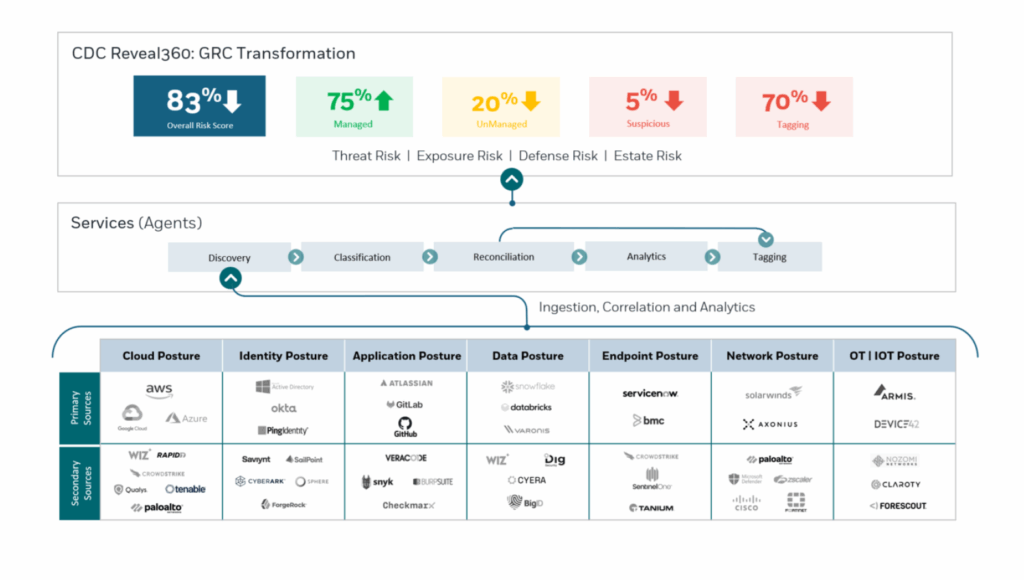
CyberProof implemented a cybersecurity estate management approach to establish a complete and authoritative inventory of the client’s cloud assets. The solution began with comprehensive discovery across Google Cloud Platform (GCP), ingesting all ~200 native asset types rather than the limited subsets supported by most security tools, delivering full visibility across the cloud estate.
The platform integrated with key security tools to automatically classify each asset as managed, unmanaged or suspicious. Using direct integrations with vulnerability management and CSPM platforms, CyberProof identified assets with active inspection, exposed gaps where no coverage existed, and surfaced discrepancies between authoritative cloud inventories and secondary security sources, highlighting potential shadow IT or misconfigurations.
To enable effective prioritization, business context was layered onto the asset inventory using cloud-native tags, including application, ownership, environment and business unit. This allowed teams to focus remediation on unmanaged assets supporting critical workloads. The extensible platform also supports rapid onboarding of new asset classes, including AI infrastructure such as GPU-based compute and model-serving services, ensuring continued visibility as the environment evolves.
Results
The initiative delivered full visibility across the client’s cloud estate, achieving 100% coverage of all ~200 GCP asset types and establishing a complete, authoritative inventory. Integration with Qualys and CSPM tools brought 95% of assets under active management, with fewer than 1% identified as suspicious and the remaining assets classified as low-risk unmanaged resources.
Automated reconciliation between GCP and security tools eliminated blind spots, surfaced previously unknown assets, and enabled rapid remediation, including agent deployment and decommissioning of unused resources. By enriching assets with business context, the client strengthened risk-based prioritization and improved the speed and accuracy of compliance reporting.
Contact us
Learn how CyberProof’s Cybersecurity Estate Management solution can help your organization lay the crucial foundation for exposure management and threat-led defense.