







Agentic MXDR gives security leaders a new way to run the SOC. It links AI agents, expert analysts, threat intel, MDR, XDR, SOAR, and hunting in one managed model. The aim is simple. Reduce risk faster, use current tools better, and keep human control where it matters.
Cloud, identity, email, endpoint, and SaaS risks now move fast. Attackers also use automation and AI. At the same time, budgets and headcount rarely grow at the same pace as alert volume. A SOC needs more than another queue. It needs a system that can reason, act, learn, and show value.
Why Enterprise SOCs Need a New Model
Many SOC teams still work in a linear way. Alerts arrive. Analysts enrich them. Tickets are opened. Escalation depends on the case, the tool, and the shift. SOAR helped by automating fixed tasks. GenAI helped with search, notes, and summaries. Yet many teams still face slow handoffs, uneven case quality, and gaps between threat intel, hunting, and response.
Agentic MXDR moves the SOC from manual work to guided, always-on defense. It does not treat every alert as a single item. It connects alerts to threat actors, high-value assets, identity risk, cloud data, known gaps, and active campaigns. That context helps the team decide what to do first.
This is where AI in Cybersecurity has real value. It is not only a faster note taker. It becomes a work layer that helps the SOC decide, test, and improve.
What Agentic MXDR Means
Agentic MXDR is Agentic managed extended detection and response with human oversight. It uses AI agents to complete repeatable work across the security life cycle. Agents can enrich alerts, build case summaries, map activity to MITRE ATT&CK, create hunt queries, review EDR health, and suggest next steps.
The key is not one smart agent. The key is a group of agents that share context through controlled orchestration. A threat intel agent can spot a campaign. A hunting agent can build a query. A detection agent can find rule gaps. An investigation agent can review linked alerts. A quality agent can check that the case follows the customer’s process.
This model keeps experts in the loop. Analysts review the logic, approve risky actions, tune rules, and handle edge cases. The result is faster work without blind trust in automation.
How Multi-Agent Workflows Improve Defense
Threat Context and Business Priority
Agentic security operations begin with relevance. A large firm does not need every indicator from every feed. It needs the threats that fit its sector, region, assets, users, and tech stack. Threat profiling agents help rank actors, campaigns, tactics, and targets.
This gives the CISO a clearer risk view. It also gives the SOC a better starting point. The team can focus on what is likely, what is active, and what could harm the business most.
Investigation and Triage
Investigation agents gather evidence from SIEM, EDR, XDR, identity, email, cloud, and ticketing tools. They can enrich an alert, group related events, check known behavior, and draft a clear case summary. They can also recommend containment or deeper review.
The analyst still owns the judgment. This is vital for high-risk cases. Human review helps control false positives, business impact, legal risk, and change approval.
Detection and Response Tuning
An Agentic SOC should learn from each case. After an alert is closed, the same data should improve hunts, rules, mappings, and playbooks. Agents can support MITRE mapping, suggest missing coverage, and convert hunt logic into queries for different tools.
This makes the SOC less reactive. New intel leads to hunts. Hunts reveal gaps. Gaps lead to new rules. Rules improve the next case.
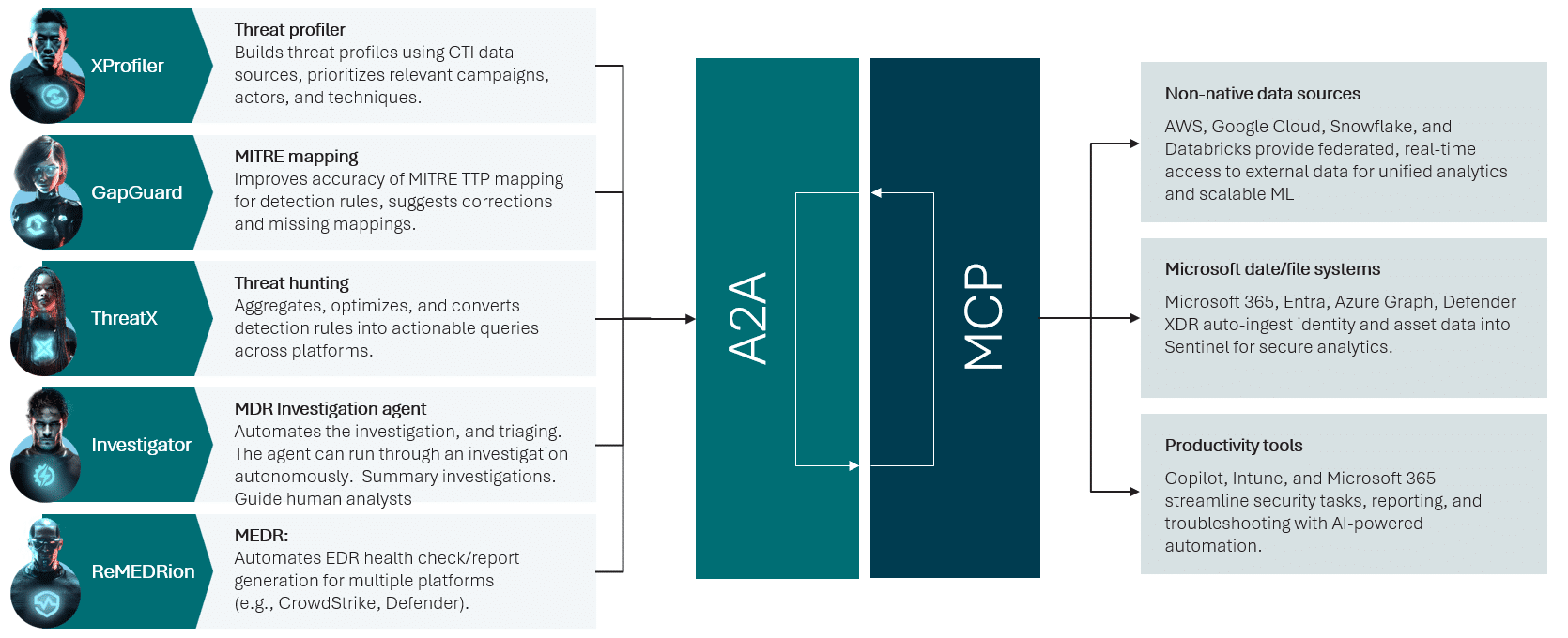
CyberProof’s AI Agents and framework
Agentic MXDR and SOC Compared With Older Models
| Area | Traditional MDR | SOAR-Led SOC | Agentic SOC and Agentic MXDR |
|---|---|---|---|
| Core work | Human case review | Fixed playbook tasks | Agent-led evidence work with analyst review |
| Context | Often alert based | Limited to workflow inputs | Threat, asset, identity, cloud, exposure, and control context |
| Speed | Depends on analyst load | Fast for known tasks | Fast for repeatable work and guided for complex events |
| Quality | Varies by shift and skill | Consistent when playbooks fit | Consistent logic, clear summaries, and QA checks |
| Improvement | Periodic tuning | Rule and script updates | Ongoing feedback from intel, hunting, cases, and MITRE gaps |
| Scale | Needs more people | Needs more scripts | Scales with agents, experts, and clear guardrails |
Using Agentic MXDR and AI in Cybersecurity With Control
AI in Cybersecurity must be safe, clear, and measured. Full trust in a black box is not fit for enterprise defense. Agentic MXDR should set limits on what agents can see, decide, and do.
A sound control model includes:
- Analyst approval for disruptive actions
- Role-based access for agents and users
- Clear logs of agent steps and evidence
- Guardrails for data, tools, and response rights
- Case QA based on the customer’s own process
- Review paths for legal, compliance, and change teams
- Reports that show agent work and human review
This keeps speed and control in balance. It also helps CIOs and CISOs defend AI use to the board, audit teams, and risk owners.
A Practical Workflow for Agentic Security Operations
A mature workflow can follow this path:
- A threat intel agent finds a campaign that may affect the firm.
- A threat profile checks fit by sector, region, assets, and tools.
- A hunting agent creates a query and tests for signs of activity.
- A detection agent checks MITRE coverage and rule gaps.
- New rules move through test mode before production use.
- An investigation agent reviews linked alerts and drafts a summary.
- A SOC analyst validates the case and approves response.
- Lessons feed back into hunts, rules, and playbooks.
This workflow shows why Agentic managed extended detection and response is more than alert triage. It links intel, hunting, detection, response, and QA in one cycle.
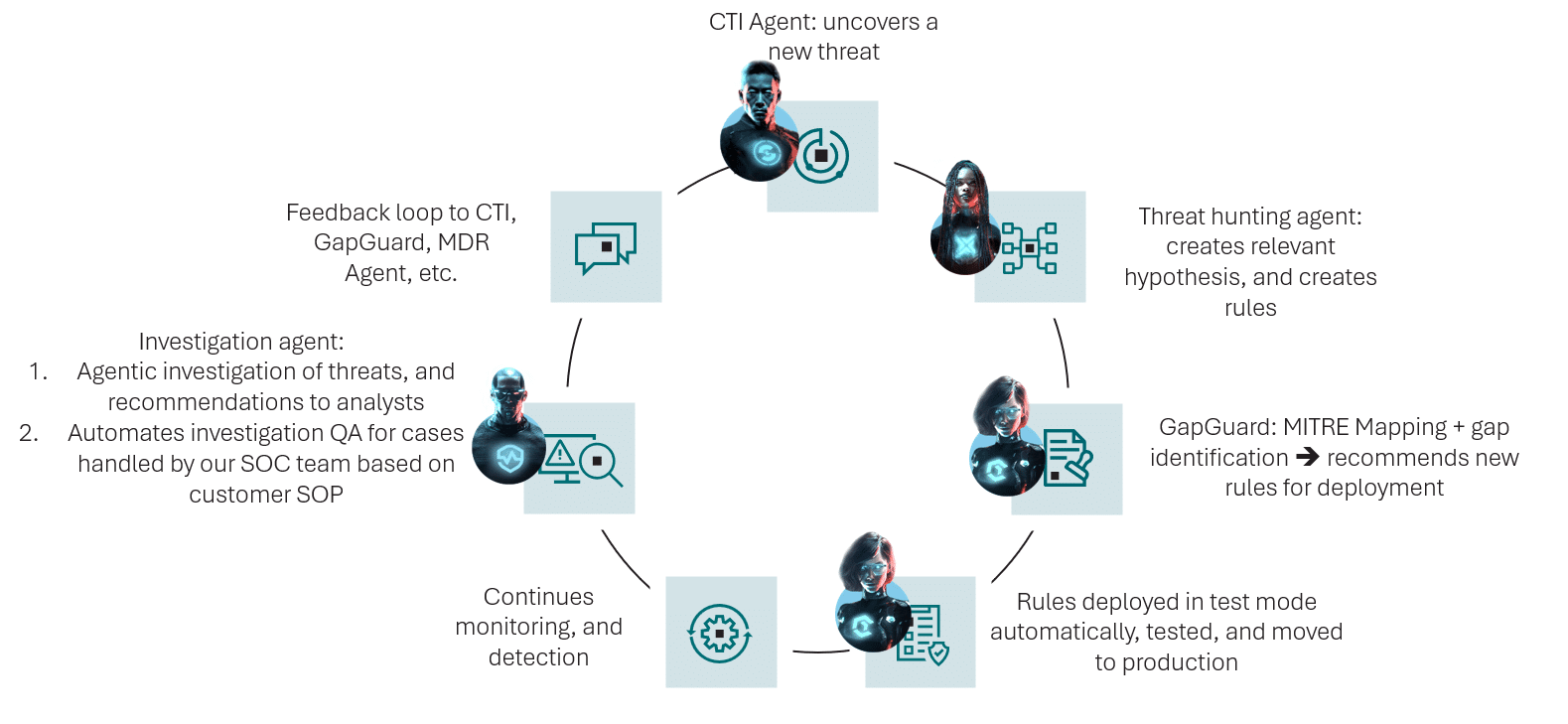
Threat led use-case generation
Agentic MXDR Metrics That Matter to Security Leaders
Agentic MXDR should be judged by outcomes. The number of agents is less important than the risk and work they reduce.
| Goal | Useful Metrics | Leadership Value |
|---|---|---|
| Faster response | Time to acknowledge, investigate, contain, and remediate | Shows if the SOC is reducing delay |
| Better quality | Evidence depth, analyst validation rate, QA results | Shows if speed is still sound |
| Stronger coverage | MITRE gaps found, rules tested, hunts completed | Shows if defense is improving |
| Less manual work | Tasks shifted to agents, analyst time saved, summaries created | Shows where AI frees skilled staff |
| Healthier tools | EDR health, log flow, connector status, enrichment gaps | Shows where blind spots remain |
| Clearer risk view | Threat profile updates, exposure links, open actions | Shows business impact and priority |
These metrics help SOC Managers run the service. They also help CISOs and CIOs show value in terms the business can use.
Architecture Principles for Enterprise Adoption
Agentic MXDR works best when it fits the existing stack. Most large firms already have SIEM, EDR, XDR, cloud, identity, ITSM, email, and data platforms. The aim is not to replace all of them. The aim is to make them work as one defense system.
A strong architecture should include:
- API-first links across security and IT tools
- Support for Microsoft, Google, and other cloud-native systems
- SIEM and EDR awareness, without hard lock-in
- Safe test spaces for new agents and rules
- Scoped access by role, system, and action
- Shared dashboards for cases, KPIs, risk, and service health
- Co-managed workflows for client teams and SOC experts
More advanced programs can also use federated data access, agent-to-agent messaging, and governed model context. These patterns let agents work with external tools and data without giving them broad, unsafe access. They also make audit trails easier to inspect.
This design helps protect past spend. The firm can gain new value from current licenses, data, and tools.
Business Value Without Uncontrolled Autonomy
The best case for Agentic MXDR is controlled speed. Security leaders do not need agents that act alone in every case. They need agents that do the heavy work, explain the logic, and let experts approve the right steps.
The value is practical:
- Less analyst time spent on enrichment and summaries
- Faster triage for known and repeatable cases
- More consistent escalation across teams and shifts
- Better use of threat intel in daily SOC work
- Faster movement from new threats to hunts and rules
- Stronger visibility through shared reports and dashboards
- More scale without relying only on new hiring
For SOC Managers, this changes the work mix. Analysts can focus on judgment, response, tuning, and complex risk. Agents handle the repetitive evidence work.
Readiness Checklist for Agentic MXDR
Before adoption, leaders should define the first use cases and the limits of autonomy. Start with areas that have clear data, clear process, and clear value.
Key steps include:
- Pick priority use cases, such as phishing, endpoint triage, cloud alerts, or hunting.
- Map required data sources, including SIEM, EDR, identity, email, cloud, assets, and tickets.
- Define which actions are advisory, approved, or automatic.
- Set KPIs for speed, quality, coverage, and risk reduction.
- Align legal, audit, and change teams on evidence and approval rules.
- Build feedback loops between intel, hunting, MDR, exposure, and detection teams.
- Require reporting on agent work, analyst review, and service improvement.
This turns AI in Cybersecurity from a trial into a managed service practice.
Conclusion: From Alert Queues to Adaptive Defense
Agentic MXDR marks a real change in security operations. It brings agents, analysts, threat intel, MDR, XDR, SOAR, hunting, and detection engineering into one threat-led model.
For CISOs, it supports faster risk reduction and clearer board reporting. For CIOs, it can extend the value of cloud and security platforms already in place. For SOC Managers, it creates a more stable way to scale work while raising case quality.
The future of the Agentic SOC is not a SOC with no people. It is a SOC where people make better decisions because agents collect evidence, share context, and improve the loop. With the right controls, Agentic security operations can move the enterprise from reactive alert handling to adaptive, threat-led defense.